 Kids & Teens
What to Do When Your Child Misses the School Bus
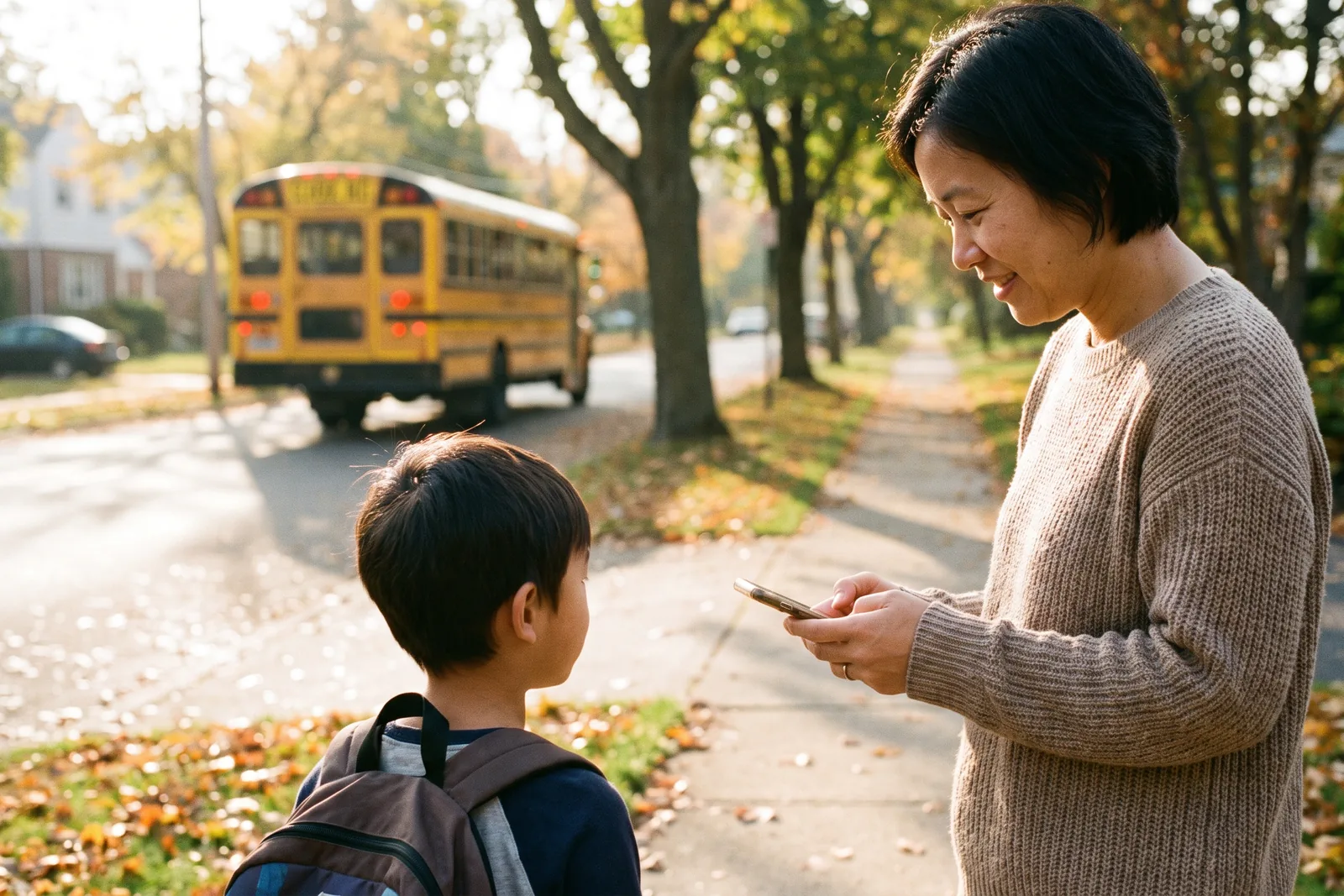
Agree one waiting spot and one first phone call before it ever happens, so a missed bus becomes a short call rather than a child wandering. Confirm where they are, choose between the next bus, a lift or a walk, and tell the school yourself. Practise the plan once and most of the panic disappears.
The first time it happened to us I was already on the motorway. My phone rang, my daughter said the word bus in a wobbly voice, and I spent the next ten minutes doing the thing every parent does: driving, worrying, and asking questions she could not really answer while standing on a kerb in the cold.
It was fine. It is almost always fine. But we handled it badly, and the reason we handled it badly is that we had never once talked about what to do if the bus went without her. She had a phone, a coat and no plan, which is a surprisingly common combination.
So this is the plan we wrote afterwards, on the back of an envelope, in about ten minutes. It has been used four times since by two children and once by a neighbour's son. Nobody has cried on a kerb again.
Make the plan before you need it
A missed bus is a logistics problem wearing an emergency costume. Everything that makes it stressful comes from deciding things in a hurry: where should she stand, should he start walking, is anyone actually coming. Decide all of that once, in advance, while everyone is calm and fed, and the morning version becomes a two minute conversation.
Keep it short enough that a distracted eleven year old can remember it. Ours fits on a fridge magnet and has three steps: stay put, call me, wait for the plan. That is genuinely the whole thing. The detail underneath it is for you, not for them.
The four things to agree in advance
- One waiting spot. A specific, visible, public place. Not roughly near the stop, an actual named spot.
- One first call. Whose number they ring first, and who they ring if that person does not answer within a couple of minutes.
- One default action. What happens if nobody answers at all. Usually: go back home, or go into a named shop or the school office.
- One rule about walking. Whether they are allowed to walk the route, and if so, which route, agreed in daylight beforehand.
Write it down where they will see it, not in a text message that scrolls away by October. A card in the school bag works. A note taped inside a pencil case works better, because it is the one thing they open in every classroom. If your household is doing a wider reset in September, fold this into your back to school family routine rather than treating it as a separate lecture.
Where to wait, and where not to
The instinct of a child who has missed the bus is to move. They walk to the next stop, or towards school, or towards a friend, and then the adult heading out to collect them cannot find them. Almost every genuinely stressful missed bus story I have heard from other parents starts with a child who did not stay where they said they would.
So the waiting spot needs to be somewhere they will actually be willing to stand for fifteen minutes. That means visible, sheltered if possible, and not embarrassing. A bus shelter, a shop doorway you have both been into, the school office if they made it that far, a neighbour's porch. Say the name of it out loud so it exists as a real place in their head.
- Good spots. The bus shelter itself, a staffed shop, a library, a leisure centre entrance, the school reception, a named neighbour's door.
- Poor spots. A park, an alleyway shortcut, a car park, anywhere with no adults and no lighting.
- Never. Accepting a lift from anyone who is not on the agreed list, however well your child knows them.
That last point deserves a proper conversation rather than a warning. Agree a short list of adults who are allowed to drive your child anywhere, and consider a family code word so that an unexpected offer of a lift can be verified in seconds. We cover exactly how to set one up in our guide to family code words for safer pickups.
Stay still and be findable beats being halfway somewhere useful.
The call, and what to actually say
Children are bad at reporting on the phone, not because they are careless but because they are embarrassed and cold. You will get I missed the bus and then silence. It helps enormously if they know the three things you are going to ask, because then they can gather them before they ring.
- 1Where are you right now. The name of the spot you agreed, not a description of the street.
- 2Are you safe and warm. A yes or no. This is the question that decides how fast anything else needs to happen.
- 3How much battery is left. This changes the whole plan, because a phone at four per cent means you agree everything now rather than checking back in ten minutes.
Then you give instructions, not options. Stay there, I am ten minutes away. Or: walk to the school office, I have rung them. A child standing on a pavement does not want to co-design a solution with you, they want to be told what happens next by someone who sounds unbothered.
The battery question is the one families forget until it bites. If your child's phone routinely dies before lunchtime, sort that separately rather than relying on it in a crisis, and read what to do when your child's phone dies so there is a fallback that does not depend on a screen at all.
Be Closer shows your whole family on one private map, free to start.
Consent-first, never sold, and gentle on your battery. iOS and Android.
Choosing the fix: next bus, lift, or walk
There are only really three answers, and knowing which one you are picking makes the decision fast. The trick is to work out in advance which is realistic on a normal weekday, because the answer for a family with two cars and flexible hours is not the answer for a family with none.
The next bus
Often the calmest option, and the one children usually resist because they will be late. Late is fine. Late with a note is completely fine. If the next service is within twenty minutes and the stop is safe, this is normally the right call, and it quietly teaches your child that a missed bus has a boring solution rather than a dramatic one.
A lift
Fastest, and the most disruptive to the adults. Before you drive, check whether anyone in your carpool circle is still nearby, because a neighbour two minutes away beats a parent twenty five minutes away every time. If you do not have that circle yet, building one is worth an evening of effort, and our guide on how to set up a school carpool walks through the awkward first messages.
Walking
Only if the route has been walked together, in daylight, and you both agree it is fine. This is a decision to make on a Sunday afternoon, not at 8:10 on a Tuesday. If your child is at the age where this is becoming realistic, the readiness questions in when can my child walk to school alone are the right ones to work through first.
Whichever you choose, ring the school yourself. Do not leave a twelve year old to explain their own lateness at a busy reception desk. A thirty second call from you turns a black mark into an administrative note, and your child arrives without a second problem to solve.
How location sharing takes the panic out of it
Most of the stress in a missed bus morning is not danger, it is uncertainty. You do not know where they are, so your imagination fills the gap while you are trying to find your car keys. Being able to look once and see that your daughter is standing at the stop where she said she would be removes about ninety per cent of that, instantly, without a single extra phone call.
It also makes the practical bit faster. You can see roughly how far away you are, tell her a realistic number of minutes rather than a hopeful one, and check the battery level on her phone before you rely on being able to reach her again. Be Closer is free to download, works in 13 languages, and shows location to within up to 95% accuracy depending on conditions, which is easily enough to tell a bus shelter from a shop doorway.
Using it well on a bad morning
- Look once, then act. Refreshing a map does not move your child. Confirm the spot, then decide.
- Check the battery, not just the pin. Battery visibility is what tells you whether to agree the whole plan now.
- Keep it two way. They should be able to see you approaching. It is the difference between being watched and being fetched.
- Say what you saw. I can see you are at the shelter, stay there. Pretending you did not look teaches them to resent it.
That last point matters more than the technology. Location sharing works in families where it is openly agreed and mutual, and it curdles quickly where it is a secret parental advantage. If you have not had that conversation properly yet, especially with an older child, talking to teens about location sharing is the one to read before you switch anything on.
Practise it once, then let it go
Run the plan as a dry run on a weekend. Walk to the stop, stand in the waiting spot, ring you from it, and talk through what you would each do. Ten minutes, once a year, usually at the start of term. Children who have physically stood in the spot behave completely differently from children who were told about it.
Then stop worrying about it. Buses get missed by organised families with good routines and lovely children. It is not evidence of anything. If it is happening every week rather than twice a term, the problem is upstream in the morning itself rather than at the bus stop, and school run morning systems has the fixes that actually hold.
And be careful how you greet them. The urge, when a stressed child gets into the car, is to explain what went wrong. Resist it until the evening. The first sentence should be a normal one, because a child who expects a telling off is a child who will one day try to solve a missed bus on their own rather than ring you. That is the only genuinely bad outcome here, and it is entirely within your control.
Frequently asked questions

Marta writes our Kids & Teens guides. Mother of two, professional over-preparer, firm believer that independence is a skill you practice, together first, then alone. She has road-tested every checklist in her own hallway at 7:40am.
Our guides are written by Be Closer's editorial voices and reviewed by the team behind the app. Questions? support@becloser.com
Published · Updated