 Kids & Teens
The back-to-school reset: rebuilding your family routine for the new school year
Reset the routine in the two weeks around the start of term, not in September when everyone is already tired. Work through it in order: sleep, the entryway launch pad, the journey plan, the communication rules, then the digital housekeeping like updating saved places and contacts. Run the whole thing as a rehearsal before day one so the first morning is boring, which is exactly what you want.
Every family I know has one September morning they still talk about. Ours involved a missing shoe, a forgotten reading folder, a child crying about a water bottle and me driving in slippers. It was the second day of term. By the third day I had learned the lesson that took me three years to actually apply: the mornings you get in October are decided by the fortnight around the start of term, not by willpower.
Summer wrecks a routine, and it should. Late bedtimes, no fixed exits, snacks whenever. That is what holidays are for. But the switch back is a real transition, and treating it as one is the whole trick. You are not asking your children to be more organised. You are rebuilding a system that got dismantled over six weeks.
This is the reset I run, in order, every year. It takes about a week of small evenings, it is boring in the best way, and it is the difference between a term of shouting up the stairs and a term of walking out of the door on time.
Start with sleep, and start before term does
You cannot fix a morning at 7am. You fix it the night before, and you fix the night before about ten days early. Children do not shift bedtimes in one jump, and neither do adults. Move it in steps and nobody has to be brave about it.
- 1Work backwards from the wake time you actually need on a school day, then add fifteen minutes of slack.
- 2Shift bedtime earlier by fifteen to twenty minutes every second night until you land on the target.
- 3Move wake time at the same pace, even at weekends during the reset week. This is the part everyone skips and the part that does the work.
- 4Put screens down at a fixed point in the evening and pick a spot where devices charge overnight, ideally outside bedrooms.
- 5Run two full dress rehearsal mornings before term starts, including breakfast and shoes on at the real time.
The rehearsal mornings feel silly. Do them anyway. You will discover that the bathroom queue is the real bottleneck, or that your eight year old genuinely cannot find socks, and you get to solve that on a day when it does not matter.
A routine you have practised once is a routine. A routine you have only discussed is a wish.
Build the entryway launch pad
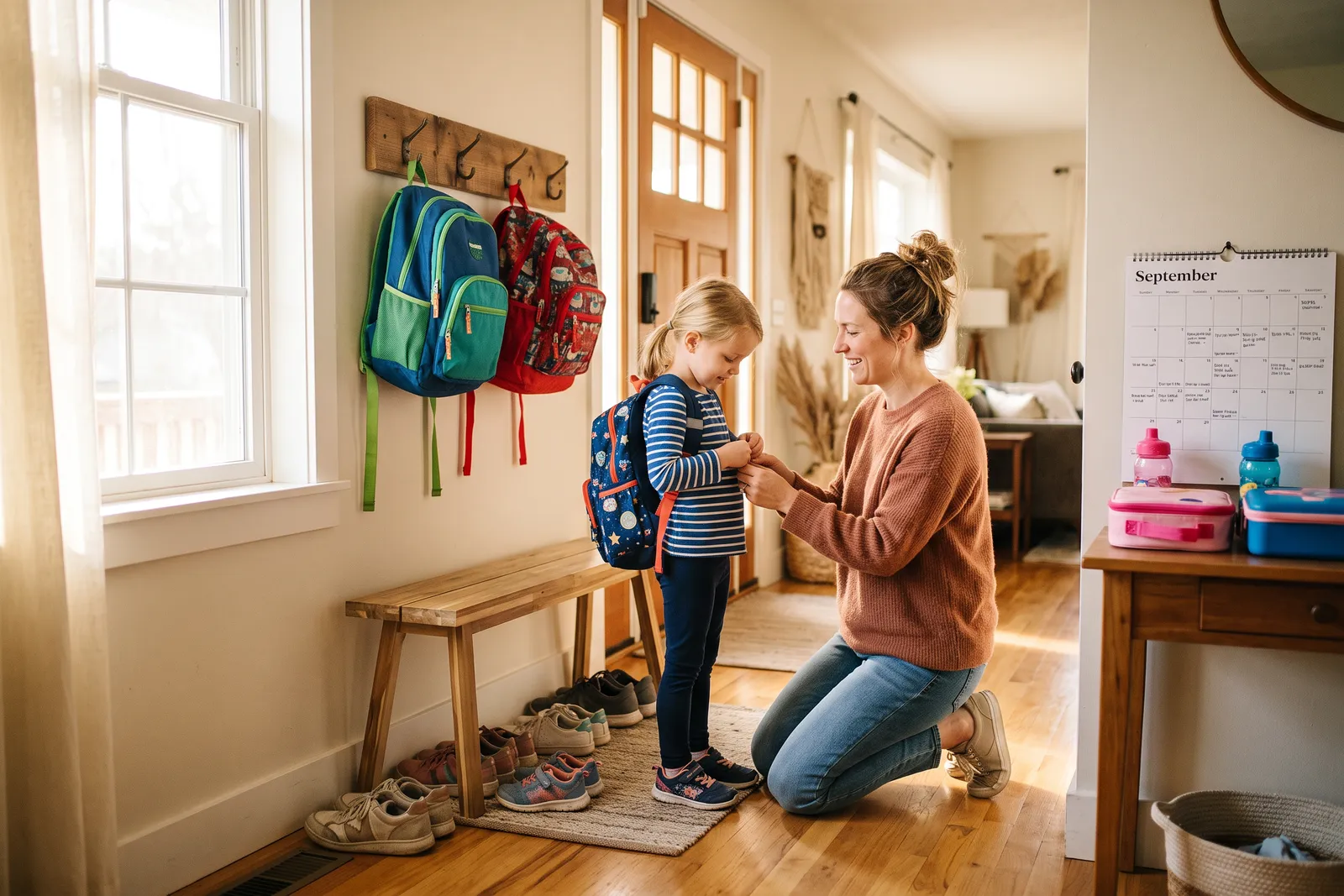
Most morning chaos is not about time. It is about searching. Bags, shoes, permission slips, the PE kit, the one glove. If everything that leaves the house lives in one square metre by the door, you delete a whole category of stress.
It does not need to be pretty and it does not need to be bought. Hooks at child height, a shoe row, a shelf or basket per child, and one shared tray for anything that must go back to school. That is it.
What lives on the launch pad
- One hook per child at their own height, so hanging the bag is easier than dropping it.
- Shoes below the hook, in a row, not in a pile. A pile is a search.
- A signed-and-done tray for forms, letters and library books that need to travel back.
- A charging spot for any phone or watch, so nobody leaves with a device on 6 percent.
- Spares box: hair ties, a folded rain jacket, a cheap water bottle, a couple of pound coins or notes for emergencies.
The night-before rule
Bags packed and on the hook before bed. Uniform out. Water bottle filled and in the fridge. Ten minutes in the evening buys you thirty in the morning, and evening you is a far more reasonable person than morning you. If you want the deeper version of this, the systems in the school run morning guide go further on sequencing and timers.
Redo the journey plan, because it changed over summer
Here is the bit families forget. The journey is not the same as last June. Your child has grown, the class has moved, the bus timetable may have shifted, and a road that felt too busy in year three might be entirely fine now. Treat the route as a fresh decision, not an inherited one.
- Walk the route together once before term, at the real time of day, so you both see the traffic and the light.
- Name the landmarks out loud: the postbox where you turn, the shop that is always open, the crossing with the lollipop person.
- Agree the crossing points, not just the direction. Most route arguments are actually crossing arguments.
- Decide the what-if: what happens if the bus is missed, if it rains hard, if a friend does not show up.
- Set the arrival expectation: a text, a wave, a check-in at the gate, or nothing at all if that is the agreement.
If this is the year your child does part of the trip alone, do it in stages rather than all at once. Walk it with them, then walk it behind them, then wait at the halfway point, then wait at home. The confidence plan in walking home from the bus stop breaks that last stretch down properly, and it applies just as well to the morning direction.
Independence is a staircase, not a door. Every step should feel slightly boring by the time you take the next one.
Be Closer shows your whole family on one private map, free to start.
Consent-first, never sold, and gentle on your battery. iOS and Android.
Agree the after-school communication rules
The gap between the last bell and getting home is where most parental worry lives, and most of it is solvable with three sentences agreed in advance. Vague expectations produce anxious parents and irritated children. Specific ones produce neither.
- 1Who is collecting, on which days. Write it somewhere shared, not in one adult's head.
- 2What counts as arrived. One message, one call, or an automatic arrival alert. Pick one and stop asking for the other two.
- 3When plans change. A change of plan needs an actual yes from an adult, not a message sent while already walking to a friend's house.
- 4What to do if nobody answers. Name a second adult and a safe place to wait. Say it out loud twice a year.
Phones make this easier and also make it messier, because a phone that is dead or on silent looks exactly like a child who is ignoring you. Practise the no-panic version of that scenario now, while everyone is calm. When your child's phone dies has the script we use, and it has stopped more than one bad evening in our house.
If this is the first-phone year
Do not hand over a phone in the first week of term. Everything is already new. Give it a fortnight, let school settle, then introduce the device with its own rules and its own conversation. The readiness checklist in is my child ready for a first phone is about behaviour rather than birthdays, which is the right way round.
The digital housekeeping nobody remembers
Every family app you use is quietly running on last year's information. New classroom, new after-school club, new friend whose house is now the Thursday stop. Fifteen minutes of tidying here saves a lot of low-level noise later.
The fifteen minute back-to-school digital sweep
- Update saved places so school, the new club venue and regular friends' homes are correct. Old places generate alerts for a life you no longer live.
- Check who is in the family circle. Add the grandparent doing Wednesday pickup, remove anyone who no longer needs to be there.
- Refresh emergency contacts on the phone and with the school office. Numbers change more often than you think.
- Test the battery reality. A school day plus an after-school club is a long day for an old phone. Decide whether a power bank lives in the bag.
- Re-read the agreement together. Location sharing works when it is mutual and understood, which is the whole argument in talking to teens about location sharing.
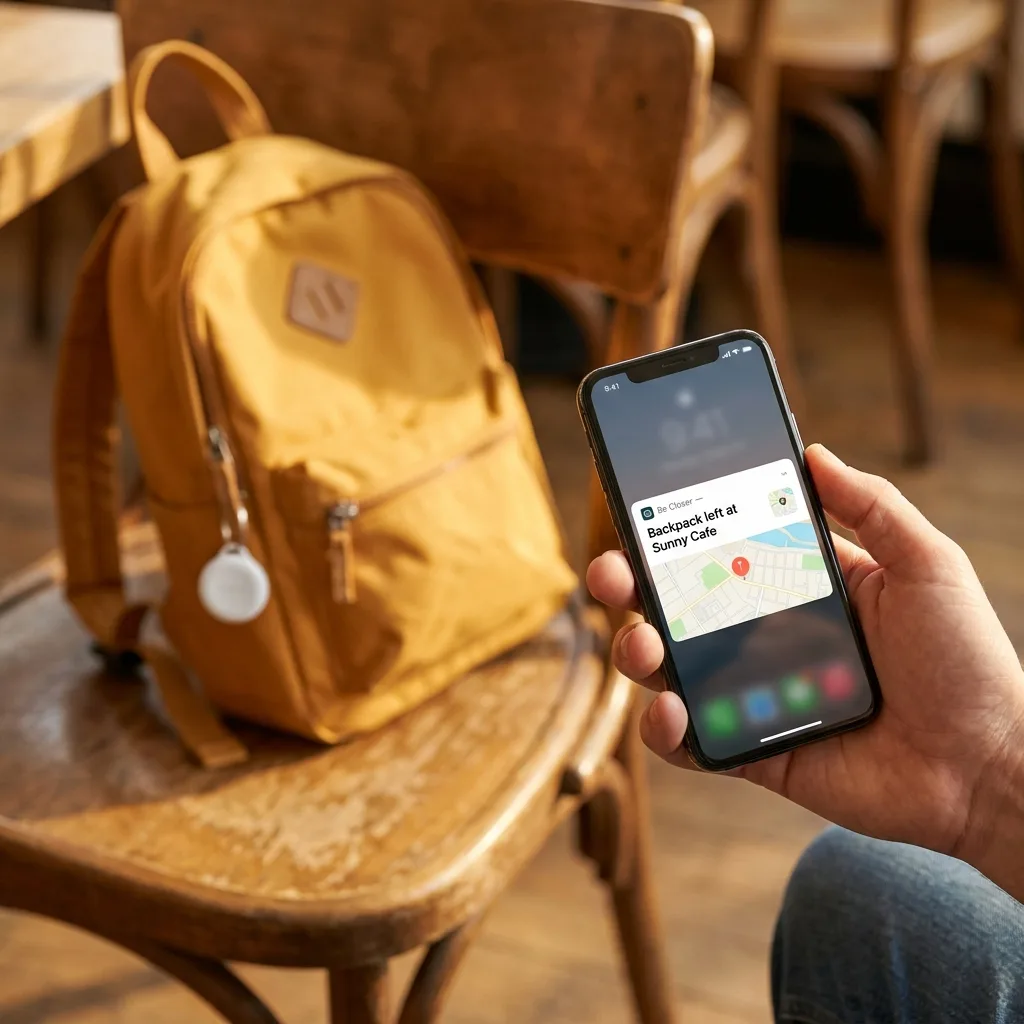
One honest note on expectations. Location tools are good, not magic. Accuracy runs up to 95 percent in good conditions, and dense buildings, tunnels and dead batteries all bend that number. Treat an arrival alert as useful information, not as proof, and keep the human check-ins as the real system. Be Closer is free to download, holds 4.4 stars across more than 150,000 ratings on the App Store and Google Play, and works in 13 languages, which matters if a grandparent in your circle prefers a different one.
Week one, and what to fix in week two
Expect the first week to be tiring and a bit wobbly. Children come home flattened. Everyone is hungrier than usual. This is normal and it is not a sign that the system failed.
- Keep evenings light. No new clubs, no big social plans, nothing that needs organising after 5pm.
- Feed them early. Half the after-school meltdowns in our house were low blood sugar wearing a costume.
- Ask one specific question, not how was school. Who did you sit with at lunch works far better.
- Write down the friction. Anything that went wrong twice is a system problem, not a child problem.
Then, at the end of week two, sit down for ten minutes and fix the two things on that list. Not ten things. Two. A routine you adjust slightly every fortnight will outlast a perfect routine you designed in August and abandoned by October.
Nobody gets a calm term by trying harder. They get it by fixing the same two things twice.
Frequently asked questions

Marta writes our Kids & Teens guides. Mother of two, professional over-preparer, firm believer that independence is a skill you practice, together first, then alone. She has road-tested every checklist in her own hallway at 7:40am.
Our guides are written by Be Closer's editorial voices and reviewed by the team behind the app. Questions? support@becloser.com
Published · Updated