 Kids & Teens
When can kids go to the mall alone with friends? A readiness guide
There is no magic age, and any number you find online is somebody else's family. Look instead for four readiness signals: your child handles money, keeps track of time, stays with the group, and knows what to do when the plan changes. When those are in place, start with a trip where you are in the building but not attached, then move to nearby, then to drop off and collect.
The first request usually arrives sideways. Nobody announces it. It comes as "Ella's mum is taking us Saturday, can we just walk around while she does her shopping?" and you have about four seconds to produce a policy you have never written.
I said not yet the first time, mostly because I was startled, and then spent a week feeling like I had done it badly. So here is the version I wish I had had ready: what actually makes a mall trip safe, what to practice first, and how to say yes in stages instead of all at once.
One note before we start. This guide is about readiness, not about ages. Some shopping centres have their own rules about unaccompanied minors and some places have local rules too, so check what applies where you live before you plan anything. Then treat the rest of this as your own family's decision, because it is.
Why the mall is a genuinely good middle step
Independence works best when you can give it in pieces. The problem with most first freedoms is that they are all or nothing: a child is either walking home alone or they are not. The mall is unusual because it hands you a version with the edges already built in.
- It is indoor and bounded. No traffic, no weather, no ambiguity about where the trip ends. A shopping centre has walls, and walls make a plan easy to describe.
- It is staffed. There are people behind counters at every turn, plus security and a service desk. Your child is never more than a short walk from an adult whose job is to help.
- It is busy in a normal way. Crowds sound alarming to parents, but a well lit space with hundreds of ordinary people going about their afternoon is a low risk environment.
- It has a natural time limit. Two hours is a whole trip. That is short enough to feel manageable and long enough to feel real.
- It is a place you already know. You have been there together dozens of times. Your child can picture the layout, which is more than they can do for most first outings.
Compare that with a first solo bus journey, which is a very good step too and which I have written about in our guide to the first solo bus ride, but which involves timetables, stops, and the possibility of ending up somewhere unfamiliar. The mall keeps the freedom and removes most of the variables.
Four readiness signals that matter more than age
When parents ask me what age is right, what they usually mean is: how do I know? These are the four things I look for, and they are all observable in ordinary life before any trip is planned.
1. They can handle money without panicking
Not budgeting in any impressive sense. Just: can they buy a thing, check the change, and notice when they are running low. If your child has never paid for anything on their own, do that first. Send them to the counter while you wait by the door. Twice is usually enough.
2. They keep track of time on purpose
This is the one that trips up the most otherwise capable kids. Time in a shopping centre disappears. Look for a child who already checks a clock without being told, who comes in from the garden when they said they would, who is not routinely surprised that an hour has gone. If they are not there yet, this is very trainable. Give them a watch and a deadline for something ordinary and let them practice.
3. They stay with the group
A mall trip is almost never a solo trip. The real safety mechanism is the group, and the child who wanders off to look at something shiny is the one who ends up alone in a place they do not know well. Watch how your child moves through a busy space with you. Do they drift? Do they notice when the group has moved?
4. They know what to do when the plan changes
This is the big one. Not what to do in an emergency, which is rare, but what to do when something mundane goes sideways: the friend's phone dies, the meeting spot is closed for cleaning, somebody wants to go somewhere that was not agreed. A ready child has an answer that starts with contacting you rather than improvising.
Readiness is not bravery. It is having a plan for the boring problems.
The pre-trip agreement
Write this down. Not because anyone will read it again, but because writing it forces both of you to be specific, and specific is what makes it work. Ten minutes at the kitchen table the night before.
The five things to settle before you go
- The meeting point. One named, fixed, boring place. The bench by the north entrance, not "near the food court". Say it out loud together until you both use the same words for it.
- Check in times. Two is plenty for a two hour trip. Halfway and fifteen minutes before pickup. Agree what a check in is: a message that gets answered, not a message that gets sent.
- The budget. An exact number, plus what happens if they want something over it. The answer is usually "then it waits until next time", and saying that in advance saves a negotiation in a shop doorway.
- Who is actually going. Names, not "and some others". If the group changes on the day, that is a message to you, not a shrug.
- The pickup plan. Where, when, and what happens if you are late. Your child needs to know that if you are ten minutes behind, they wait at the meeting point rather than starting to solve it themselves.
Add one more thing that is not a rule: a code word. A short phrase your child can send or say that means come and get me now, no questions in front of my friends. We keep ours deliberately dull so it never gets guessed. There is more on how to choose one and how to practice it in our guide to family code words.
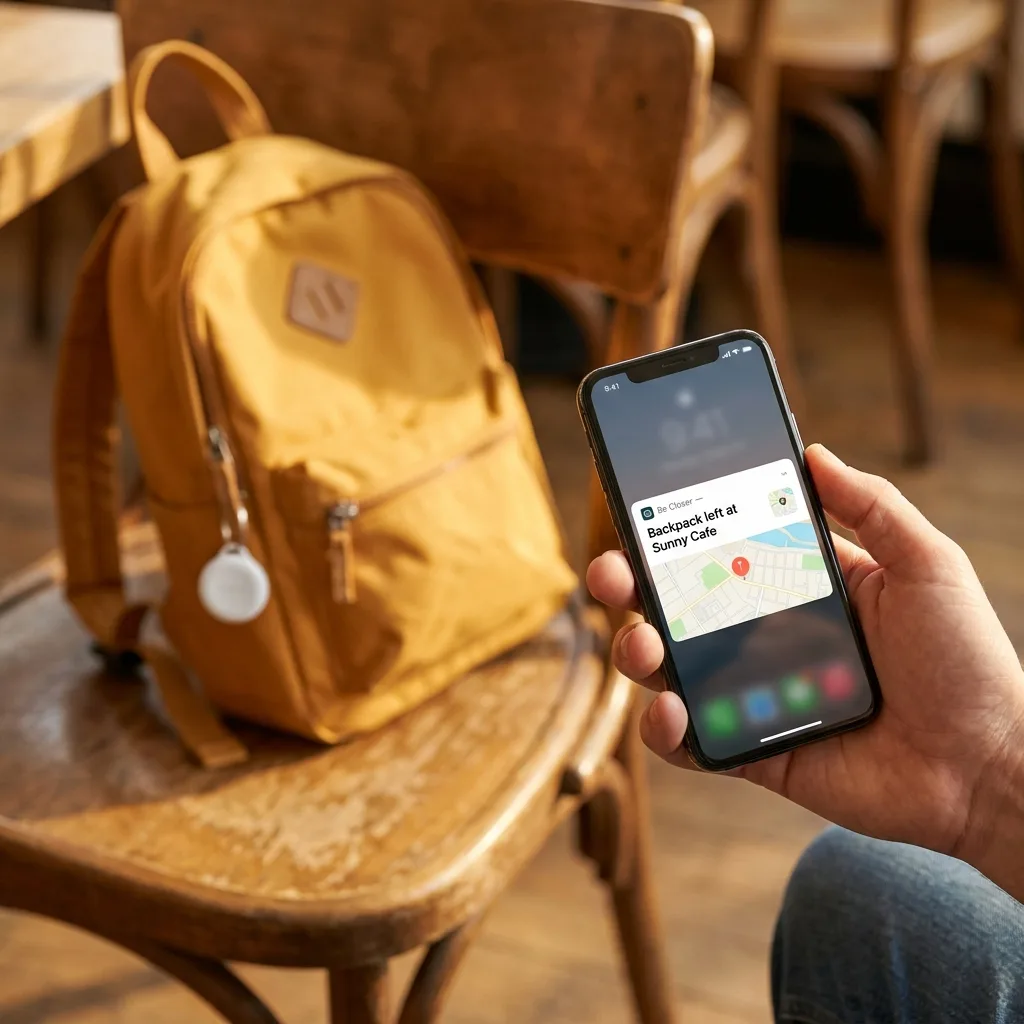
If your family shares location, this is the moment to say plainly how it works today. Not as a condition of the trip, and not as a gotcha. Something like: I can see where you are, you can see where I am, I am not going to be watching the screen, and I will call rather than appear. Be Closer is free to download and shows shared location to up to 95% accuracy, but the accuracy is not the point. The point is that both of you agreed to it out loud.
Structure the first trip in three steps
Do not go from never to two hours unsupervised in one Saturday. Stagger it, and let each step be genuinely boring before you move on.
- 1In the building, separately. You do your own shopping. They do theirs. You meet at the agreed point after forty five minutes. This sounds like a token gesture and it is not: for most kids this is the first time they have moved through a public space with no adult attached, and it feels enormous.
- 2Nearby. You are in the café across the road or in the car park with a book. Ninety minutes, two check ins. This is the step where the phone becomes the connection rather than your eyeline, so it is worth doing before the real thing.
- 3Drop off and collect. Two hours, one check in halfway, one at pickup. You are at home. Everyone will survive this, including you.
Space these out over a few weeks. If a step goes badly, and by badly I mean a missed check in rather than anything dramatic, repeat that step rather than going backwards to the start. Repeating is not a punishment, it is practice.
Be Closer shows your whole family on one private map, free to start.
Consent-first, never sold, and gentle on your battery. iOS and Android.
The group is the plan, and the group is also the risk
Here is the part that has almost nothing to do with safety in the way we usually mean it. Most mall trips that go wrong go wrong socially. Somebody dares somebody. A shop assistant asks the group to leave. One child is quietly frozen out and spends an hour trailing behind. These are the real events of a Saturday afternoon at that age.
So brief for that too, and brief for it lightly. Three sentences over breakfast is more effective than a lecture in the car park.
- Nobody splits up. If the group divides, it divides into pairs, never into one. Say this as a group rule rather than a rule for your child, because it is easier to hold.
- You are allowed to be the boring one. Give them a ready made line: "my mum tracks the time, I have to be at the bench at four". Being able to blame you is a gift. Offer it explicitly.
- Shops are not a game. Daring each other in a shop ends the mall as an option, for everyone. Kids respond well to consequences that are shared rather than personal.
- If it stops being fun, that is a reason to leave. Not a failure. Use the code word, or just call. There is no version of this where I am annoyed that you rang.
It is also worth walking through what happens if the group gets separated, which is by far the most likely mishap of the day. We have a full script for that in the if we get separated plan, and the short version is: stop moving, go to the agreed point, call.
How to say not yet without it becoming a fight
Sometimes the honest answer is no. The trick is to make the no about a specific missing thing rather than about your child's character, because a no with a route out of it is a no that gets accepted.
What does not work: "you are not old enough". It is unanswerable, which sounds like a strength and is actually the problem. Your child cannot do anything about their age, so all it leaves them is resentment and a countdown.
What works: name the gap and name the practice. "Not this weekend. You have missed the come home time twice this month, so let us fix that first, and then yes." Then follow through when they fix it, quickly and without making them ask twice. The follow through is the whole thing. A child who learns that meeting the condition actually produces the freedom will meet the next one too.
Every no should come with a yes attached to it, and a date you actually keep.
And when you do say yes, say it cleanly. No sighing, no list of everything that could happen, no last minute additions to the agreement in the car. You did the preparation. Let them have the afternoon.
Afterwards, ask better questions
"How was it" gets you "fine". Ask something with a shape to it instead, in the kitchen, while doing something else, because side by side conversations always go better than face to face ones at this age.
- What was the most annoying part?
- Did anything nearly go wrong?
- Was there a moment you were not sure what to do?
- What do you want to do differently next time?
Then let it go. The debrief should take four minutes, not the evening. If something came up that needs addressing, address it tomorrow rather than the moment they walk in glowing from their first taste of a Saturday that belonged to them.
That glow is the point of the whole exercise. Everything above is scaffolding for it.
Frequently asked questions

Marta writes our Kids & Teens guides. Mother of two, professional over-preparer, firm believer that independence is a skill you practice, together first, then alone. She has road-tested every checklist in her own hallway at 7:40am.
Our guides are written by Be Closer's editorial voices and reviewed by the team behind the app. Questions? support@becloser.com
Published · Updated