 Kids & Teens
The 'if we get separated' plan every family needs
Pick a meet point the moment you arrive anywhere crowded, every single time, no exceptions. Teach your child to stay put rather than search, and to approach staff in uniform, a parent with kids, or a shop counter, not just 'someone kind-looking'. Rehearse this at low stakes, like the supermarket, so it's a habit and not a speech they half-remember when it matters.
Every parent has had the two-second version of the nightmare: you turn around at the till, or the carousel, or the crowd surging toward the stage exit, and the small person who was holding your hand is not holding your hand. It's almost always over in under a minute. But that minute is worth planning for, because a plan turns panic into a checklist, and checklists are things both children and frazzled adults can actually follow.
The good news is that this doesn't require a serious sit-down talk about danger. It requires one habit, repeated so often it becomes boring, and a couple of rules your child can say back to you half-asleep. Boring is the goal. Boring means it's automatic.
This guide covers the meet-point habit, what a child should actually do in the first minute, who's safe to approach, and how to adapt all of it for the specific chaos of theme parks, airports, festivals and beaches.
What's the one habit that matters more than any speech?
Pick the meet point on arrival. Not once a year, not 'we'll figure it out', every single time you walk into somewhere crowded, within the first two minutes, you point at something and say, "If we get split up, that's where we meet." It takes ten seconds and it costs nothing, and it is by far the most useful thing in this entire guide.
Choose something fixed, large, and named, not 'near the ice cream van' (it moves), but 'the clock tower', 'the information desk with the blue sign', 'the lifeguard hut'. Say it out loud, get your child to repeat it back, and if they're old enough, point it out physically so they've actually seen it rather than just heard it.
The two-minute arrival ritual
- Point out the meet point and name it clearly.
- Ask your child to repeat it back to you in their own words.
- Agree what to do if it gets dark or the venue closes (a second, indoor option helps here).
- Check what they're wearing so you have a clear description in your head, not just 'a blue thing, I think'.
What should a child actually do in the first minute?
The instinct to run and search for you is understandable and almost always makes things worse, now two people are moving through a crowd instead of one person standing still. Teach the opposite instinct: stop, stay exactly where you are, and let the finding happen around you rather than by you.
- Stop moving. The single hardest rule to teach and the most important one. A stationary child is far easier to find than a moving one.
- Look for the meet point if it's visible and safe to walk to calmly, otherwise stay put and let an adult help.
- Approach a safe adult rather than waiting silently, especially in a crowd that's still moving past.
- Say your name and a parent's name and phone number, not just 'I'm lost', the more specific detail an adult has, the faster this resolves.
This is also a good moment to be honest that most separations end within a few minutes, resolved by exactly this: a child standing still, an adult retracing steps, a meet point doing its job. Naming that plainly is more reassuring than pretending it will never happen.
Who should they actually approach?
"Ask someone kind-looking" is not a real instruction, everyone looks kind-looking to a frightened eight-year-old, including people who aren't paying attention at all. Give a concrete, ordered list instead.
- 1Staff in uniform, a name badge, a lanyard, a branded polo shirt. This is the clearest, easiest-to-spot signal you can teach.
- 2A shop or stall counter, someone behind a till has a fixed location and a reason to help, and your child can simply walk up and stay there.
- 3A parent who's clearly with their own children, statistically a safe, unhurried, non-threatening option, and one children tend to find approachable.
- 4Security or a police officer, if visible, obvious, but worth saying explicitly so it's on the list rather than assumed.
Practise the sentence too: "I've lost my mum, my name is ___, her phone number is ___." A child who has said this out loud before will say it far more clearly when it actually matters.
Be Closer shows your whole family on one private map, free to start.
Consent-first, never sold, and gentle on your battery. iOS and Android.
How do you rehearse this without making it scary?
The supermarket is the best training ground there is, because the stakes are genuinely zero. Next time you're there, let your child wander two aisles ahead, within your sightline, and when they look back and can't immediately see you, watch what they do. Most children's first instinct is to search. Gently redirect: "Next time, stay right there and I'll come to you." Do this a handful of times over a few months and the instinct rewires itself.
You can turn it into a small game rather than a lesson: "Quick, if I disappeared right now, where would you go?" asked cheerfully in a car park or shopping centre gets a genuine, thought-through answer far more often than the same question asked seriously at the dinner table.
How does this change at theme parks, airports, festivals and beaches?
| Setting | What's different | What to add |
|---|---|---|
| Theme parks | Huge, loud, and full of near-identical costumed staff | Agree a meet point per zone, since one for the whole park may be a 20-minute walk away |
| Airports | Security barriers can physically separate you | Teach your child to go straight to any uniformed staff member, not to try to pass back through security |
| Festivals | Deafening, dark at night, phone signal often patchy | Write your number on their arm or wristband in permanent marker before you go, not after |
| Beaches | Wide open, everyone in similar swimwear, no obvious landmarks | Use the lifeguard hut or flag as the meet point and check it's visible from wherever you set up |
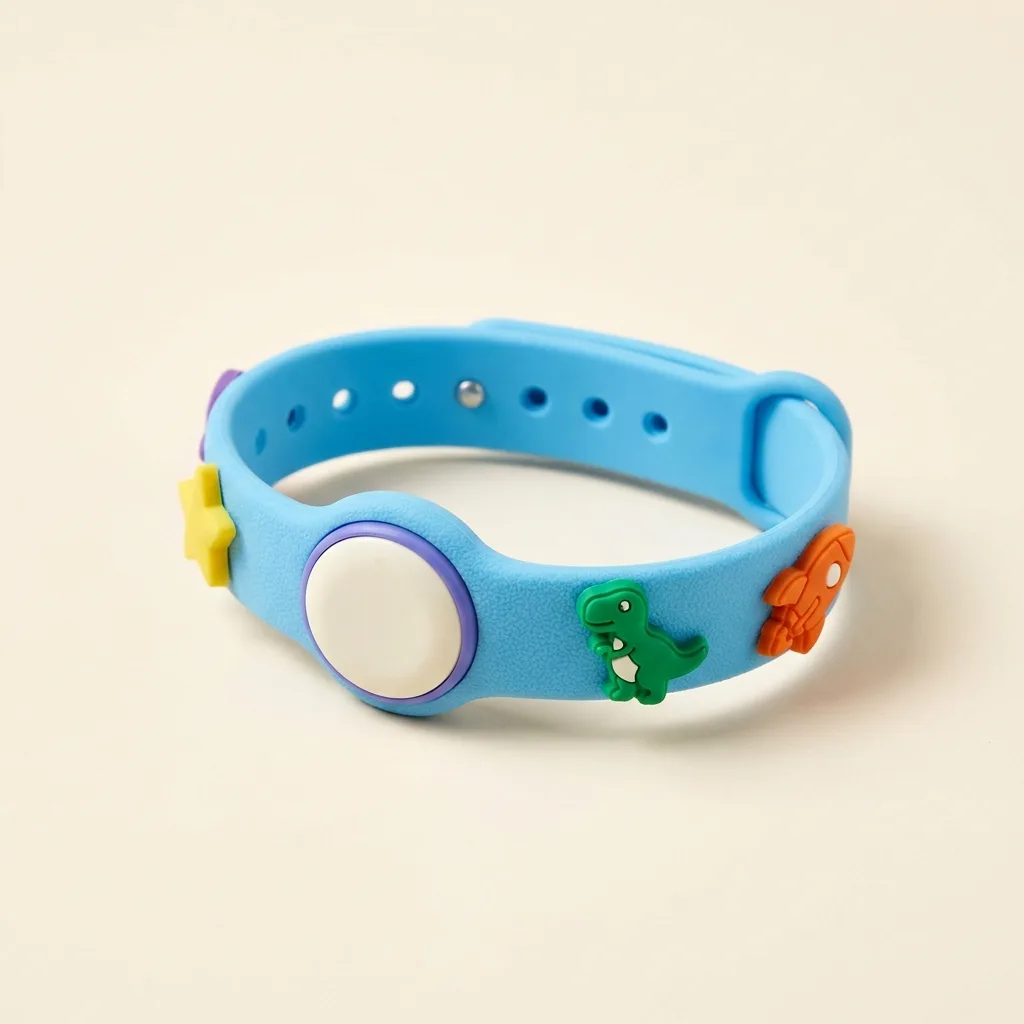
The written-number trick deserves its own mention because it works at any of these. A phone number in permanent marker on a forearm, or written on a card tucked into a wristband, survives noise, tears, and a dead phone battery in a way that memory sometimes doesn't at age six. A device like the Be Closer Band does something similar with less fuss, it's worn, not carried, and it gives you a live location the moment you notice they're not beside you, rather than waiting for a shout across a crowd.
What should the adult do in the first two minutes?
Your job is to move less than instinct tells you to. The urge is to sprint in whatever direction feels most likely, resist it for the first sixty seconds and instead check the obvious: the exact spot you last had contact, and the meet point, in that order. Most separations resolve in the time it takes to walk calmly between those two places.
- 1Stay roughly where you last saw them for the first thirty seconds, children double back more often than adults expect.
- 2Walk to the meet point next, scanning as you go rather than sprinting past everything.
- 3Alert nearby staff immediately with a description, don't wait to see if you'll find them yourself first.
- 4If you have a location tracker set up, check it before you do anything else, it removes the guesswork entirely.
The parents who handle this best aren't the ones who never lose sight of their kids. They're the ones whose kids already know exactly what to do about it.
Frequently asked questions
Marta writes our Kids & Teens guides. Mother of two, professional over-preparer, firm believer that independence is a skill you practice, together first, then alone. She has road-tested every checklist in her own hallway at 7:40am.
Our guides are written by Be Closer's editorial voices and reviewed by the team behind the app. Questions? support@becloser.com
Published · Updated