 Kids & Teens
Should Kids Answer the Door When Home Alone?
For most families the simplest rule is that kids home alone do not open the door, full stop. Agree on a short list of exceptions in advance, practise a few calm phrases they can say through the door, and use check-ins and arrival alerts so everyone feels connected without constant calls.
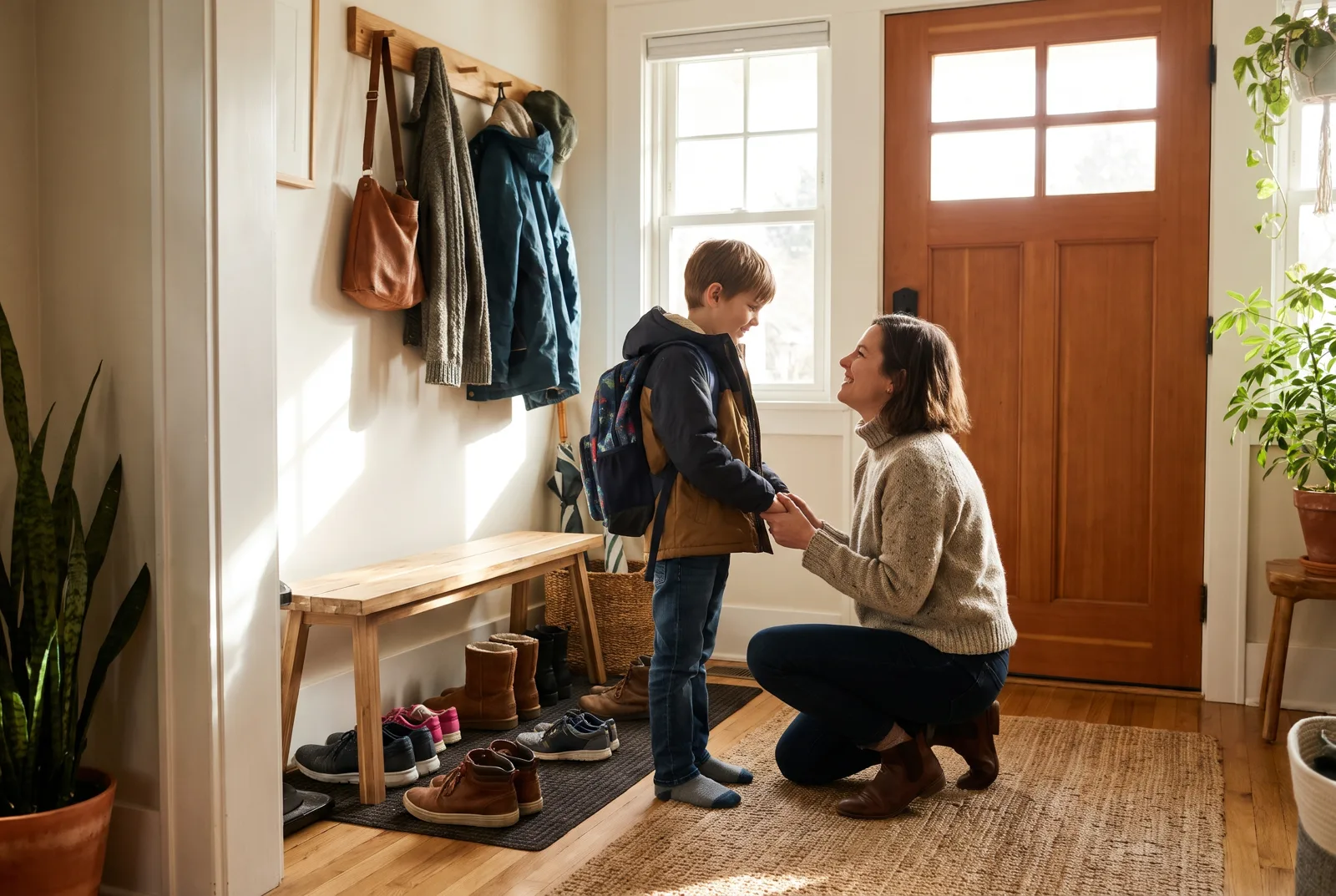
The first afternoon my son stayed home alone, the doorbell rang eleven minutes after I left. I know because he called me at minute eleven and a half, whispering from behind the sofa. It was a parcel. He had not opened the door, which was good. He had also not breathed in a while, which was less good.
That evening we sat in the hallway and made a plan. Not a long lecture, just a clear rule, a couple of exceptions and some words he could say out loud. The next time the bell rang, he handled it like it was nothing.
If your child is starting to stay home alone, **the door is one of the first things to sort out.** Here is how we did it, and what I have learned from many other parents since.
The default rule: we don't open the door
Most families find the easiest starting point is a simple, unbreakable rule: when you are home alone, you do not open the door. Not for a friendly face, not for someone in a uniform, not for someone who says they know Mum.
Simple rules work because children do not have to judge anything in the moment. Judging a stranger's story is hard for adults. Asking a child to do it while their heart is racing is unfair. A clear default takes the pressure off.
Why a firm default helps
- There is nothing to weigh up, so there is nothing to get wrong.
- Visitors with genuine reasons can always come back or call you.
- Your child never has to feel rude, because it is a family rule.
- It is easy to remember when they are nervous.
Whether your child is ready to be home alone at all depends on them and on local rules, which vary from place to place, so check what applies where you live. Our guide on when a child can stay home alone walks through the readiness signs.
Exceptions your family can agree on
Some families keep the rule absolute. Others add a very short list of exceptions. Both are fine. The important part is that exceptions are agreed in advance, never invented on the doorstep.
- A named person you have told them is coming, like Grandma at four o'clock, and only after they have checked with you by phone.
- A family code word. If someone claims you sent them, they must know the word. Our guide to family code words explains how to choose one.
- A real emergency, such as fire or smoke, where the rule flips: get out of the house, do not wait at the door.
Notice what is not on the list: neighbours dropping by, someone asking to read the meter, a friend's parent. Those visitors can come back later. Keeping the list tiny keeps it clear.
Exceptions are decided at the kitchen table, never at the front door.
Scripts kids can use through the door
Some children prefer to stay completely silent and let the visitor think nobody is home. Others feel calmer saying something. Either choice is fine, so let your child pick. If they want words, give them a few short, practised phrases:
- 1"My parent can't come to the door right now. Please come back later."
- 2"Please leave it on the step, thank you."
- 3"I can't open the door. You can call my mum."
Notice that none of these say "I'm alone." That is deliberate. Teach your child never to tell a visitor, a caller or anyone online that they are home by themselves.
Then practise. It sounds silly, but role play works. Stand outside, ring the bell and let them try each line. Play a pushy visitor once or twice so they hear themselves stay firm. After two or three runs, most kids find it boring, which is exactly what you want.
Deliveries without the stress
Parcels are the most common reason the bell rings. A few small habits make them a non-event:
- Add delivery notes asking couriers to leave parcels without knocking.
- Choose a safe spot or a locker for days your child is home alone.
- Tell your child that a missed parcel is fine. It can always be redelivered.
- Agree that they never sign for anything or open the door to hand something over.
If a parcel needs to come in, they can wait until the courier has left and the street looks clear, then bring it in quickly. Or simply leave it until you get home. Nothing in a box is worth the worry.
Be Closer shows your whole family on one private map, free to start.
Consent-first, never sold, and gentle on your battery. iOS and Android.
When the visitor won't go away
Most doorbell rings end within seconds. Occasionally, though, someone knocks again, rattles the handle or keeps talking through the door. Your child needs to know that this situation has its own simple plan, and that following it is never an overreaction.
- 1Move away from the door to a room where they feel safe, ideally one with a phone signal.
- 2Call you or the backup adult and say plainly what is happening.
- 3If they feel scared or someone tries to get in, call emergency services. Make sure they know the number and what to say, including their address.
- 4Stay inside until a trusted adult arrives or tells them it is okay.
Children sometimes worry about "getting someone in trouble" or "wasting" an emergency call. Tell them clearly that you would always rather they called and it turned out to be nothing. Feeling frightened is a good enough reason to ask for help.
It is also worth practising what to say if the visitor asks questions. Your child does not owe anyone answers. "I can't help you, please call my parent" is a complete sentence. They can repeat it as often as needed, or simply say nothing at all.
Phone calls, video doorbells and other doors
The front door is not the only way people reach a child at home. Landline calls, messages and video doorbells all deserve a quick mention in your plan, because the same principles apply to each of them.
- Unknown callers: many families let them go to voicemail. If your child answers, they say a parent is busy and offer to take a message, never that they are alone.
- Video doorbells: seeing the visitor can be reassuring, but it does not change the rule. A friendly face on a screen is still not on the exceptions list.
- Back doors and gates: if someone knocks at a side entrance, the same rule applies. Keep every door locked, not just the front one.
- Messages from unknown numbers: no replies, and show a parent later.
Review the plan every few months. As your child grows, you may relax some parts, such as letting them answer the phone to known numbers. Make those changes together and say them out loud, so the rule they are following is always the current one.
Feeling scared is always a good enough reason to call for help.
The rest of the home-alone safety plan
The door is one piece of a wider plan. Before your child's first solo afternoon, run through the basics together:
Home-alone basics
- Doors locked once they are inside, and the key kept in its spot.
- Your number and a backup adult's number memorised.
- What to do if the phone rings, which usually follows the same rules as the door.
- How to call emergency services and what to say.
- Which neighbour they can go to if something feels wrong.
Our guide to after-school alone hours covers snacks, screens and homework too. A predictable routine makes the whole afternoon feel safer.
How check-ins and arrival alerts reduce the worry
Much of the anxiety around being home alone, for parents and children, comes from not knowing. Did they get in? Are they okay? A simple check-in routine fixes most of that.
Agree on one quick check-in when they arrive home, and another at a set time later. A short message or a thumbs-up is plenty. Many families also use arrival alerts in a location sharing app, so a parent gets a notification when their child reaches home without anyone needing to text.
BeCloser is one app families use for this. It is free to download, has more than 10 million downloads, and offers up to 95% location accuracy. Like any tool, it works best when your child knows it is on and understands why. It should help them feel supported, not watched.
And remind them that the doorbell is never a reason to panic-call. If something worries them, they call you. If it is a parcel, it can wait for the evening check-in.
Frequently asked questions
Marta writes our Kids & Teens guides. Mother of two, professional over-preparer, firm believer that independence is a skill you practice, together first, then alone. She has road-tested every checklist in her own hallway at 7:40am.
Our guides are written by Be Closer's editorial voices and reviewed by the team behind the app. Questions? support@becloser.com
Published · Updated