 Kids & Teens
When Can My Child Stay Home Alone? A Readiness Checklist
A child is ready to stay home alone when they can lock up, follow a clear door policy, reach you, and stay calm when something unexpected happens, not when they hit a particular age. Check any local guidance first, practise the skills, start with a 20 to 30 minute trial, and build up gradually with a house rules card on the fridge.
The first time I left my daughter home alone, I was gone for 25 minutes. I went to the pharmacy two streets away, and I checked my phone at every red light. When I got back she was on the sofa with a book, completely unbothered, and slightly offended that I had rushed.
That moment did not come out of nowhere. We had spent a few weeks getting ready: practising the lock, talking through the doorbell, writing a rules card for the fridge. By the time the day came, the only person who was nervous was me.
If you are wondering whether your child is ready, here is the honest answer from one parent to another: **readiness is about skills and temperament, not a birthday.** Some children are ready earlier than you expect, and some confident, capable children still need more time. This checklist helps you tell the difference.
First, check your local guidance
Some regions publish guidance on when children can be left alone, and a few have rules. They vary a lot from place to place, so look up what applies where you live before you plan anything. Your local council, child services website, or school office is a good place to start.
Treat that guidance as the floor, not the finish line. Even where there is no rule at all, the real question is still the same one: can this particular child handle this particular stretch of time, in this home, today?
Signs your child might be ready
You know your child better than any checklist. Still, these are the signs I looked for, and the ones other parents in our school group mentioned most often.
- They want to. A child who asks to stay home is far more likely to cope than one who is being talked into it.
- They follow agreed rules when you are not in the room, most of the time.
- They can keep themselves busy for half an hour without a screen or a sibling.
- They handle small surprises calmly, like a spilled drink or a lost sock, without panicking.
- They tell you when something worries them, rather than hiding it.
- They are comfortable being in the house when it is quiet.
If most of those sound like your child, you are probably in the right territory. If several do not, that is not a failure. It just means the practice stage will take longer, and that is fine.
Skills to practise before the first time
This is the part most parents skip, and it is the part that matters most. Confidence comes from rehearsal, not from a pep talk. We practised each of these a few times while I was home.
Home alone skills checklist
- Locking and unlocking the front door, including a sticky lock or a key that needs jiggling.
- Knowing where the spare key is, or who holds one.
- Saying their full address and your phone number from memory.
- Calling you, a second trusted adult, and emergency services.
- Using the microwave or kettle safely, or knowing they are off limits.
- Knowing which rooms and appliances are out of bounds.
If memorising numbers feels like a stretch, this guide to teaching address and phone numbers has games that make it stick. And if your child will be letting themselves in, the first house key guide covers where to keep it and what to do if it goes missing.
The door policy
Decide this together and keep it simple. In our house the rule is: we do not open the door to anyone, even people we know, unless a parent has said so first. Parcels can be left, neighbours can come back later, and nobody needs an explanation.
Practise it. Ring your own doorbell and see what happens. The first time I did this, my son opened the door with a big grin because he knew it was me. That was a useful lesson for both of us.
What to do if something feels wrong
Children need permission to act on a bad feeling. Tell them clearly: if something feels wrong, you can always call me, and you will never be in trouble for it. Walk through a few what ifs together: a strange noise, a smoke alarm, a cut finger, a power cut. For each one, agree on the first step.
The first trial run
Keep the first time short, planned, and a little boring. A boring success is exactly what you want.
- 1Pick a time of day when your child is rested and fed, not tired and hungry after school.
- 2Choose a short, nearby errand: 20 to 30 minutes is plenty.
- 3Tell them where you are going and when you will be back.
- 4Agree one check-in, such as a quick message when you arrive at the shop.
- 5Come back on time. Being late on the very first run can knock their confidence.
- 6Talk afterwards: what felt easy, what felt strange, what they would like to change.
The debrief matters more than the trial. It turns one afternoon into a skill they own.
Put the house rules on the fridge
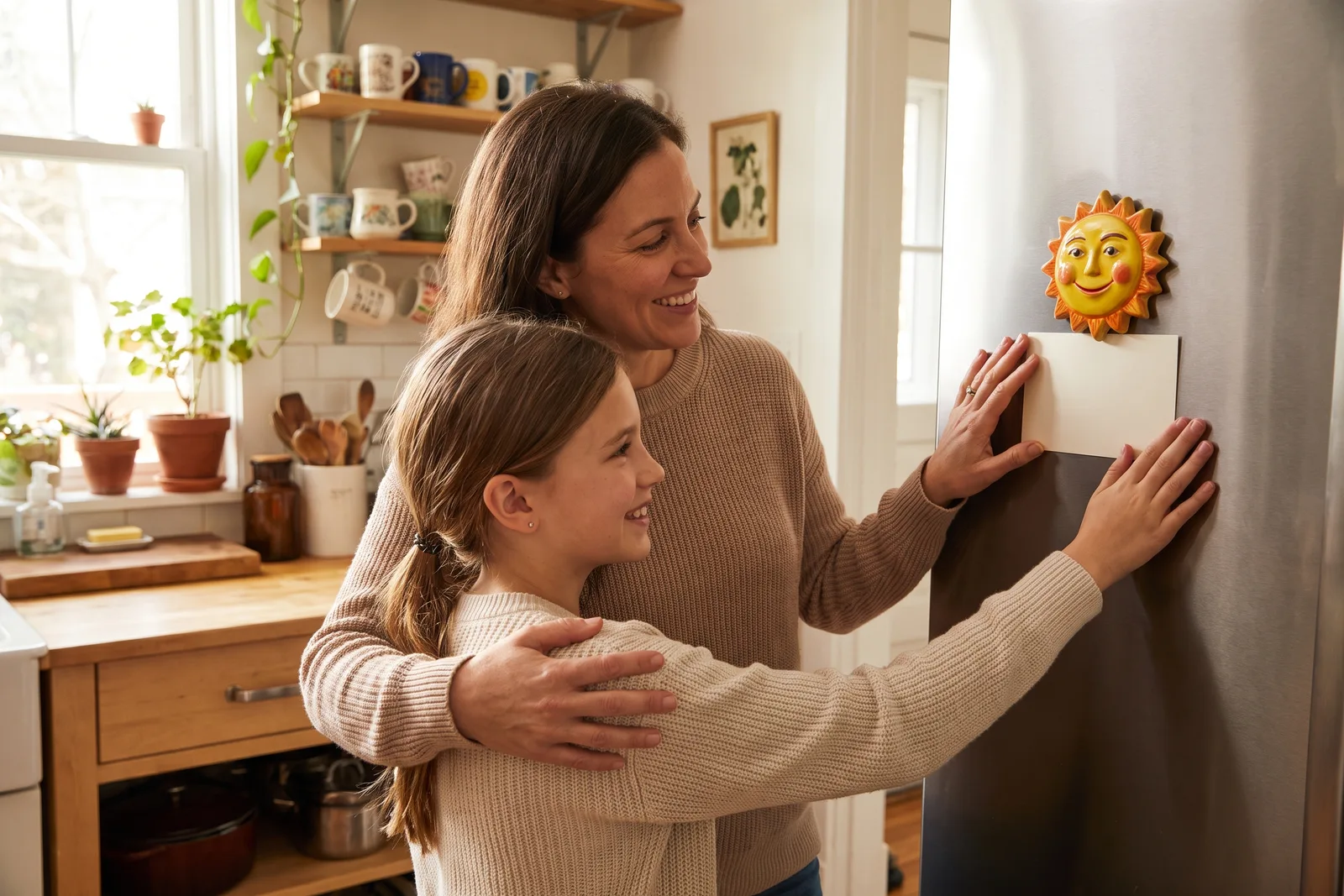
We wrote ours on an index card and pinned it at eye level on the fridge. My daughter decorated the border, which I suspect is why she actually reads it. A written card removes the guesswork when you are not there to ask.
What goes on the card
- Your number and a second trusted adult's number.
- The home address, written out in full.
- The door rule, in one line.
- Snacks that are allowed, and appliances that are not.
- Screen rules for home alone time.
- What to do in an emergency: get out first, then call.
Keep it to one card. If it needs a second page, it is too complicated for a child to use when they are flustered.
Be Closer shows your whole family on one private map, free to start.
Consent-first, never sold, and gentle on your battery. iOS and Android.
Build up gradually
After a few smooth short runs, stretch the time bit by bit. Thirty minutes becomes an hour. A daytime errand becomes the hour after school. The key is to move one thing at a time, so if something goes wrong, you know what changed.
- Increase the time before you change the time of day.
- Add a sibling only once each child is confident alone, and agree who is in charge of what.
- Leave evenings and darkness until last, when your child is truly settled.
- Check in regularly about how it feels. Readiness can go backwards after a scare, a move, or a tough week at school.
If your child will regularly come home to an empty house after school, this guide to after-school alone hours goes deeper into routines, snacks, and homework.
Siblings, friends, and the doorbell problem
Once the basics are solid, the tricky situations are usually social rather than practical. A friend knocks and asks if your child can come out. A younger sibling wants a snack from the top shelf. A neighbour wants to drop something off. None of these are emergencies, but they are exactly the moments when a child is tempted to bend the rules.
Talk them through in advance. Children cope much better with a situation they have already imagined. We played a quick round of what would you do over breakfast for a week, and by the end my daughter had an answer ready for almost everything.
- A friend at the door: "I can't come out right now, I'll message you later."
- A delivery: leave it, or ask the courier to use the safe spot.
- A sibling argument: separate rooms, then call a parent if it does not settle.
- An adult they do not expect: do not open the door, call a parent straight away.
If you have more than one child at home, be very clear about who is in charge and what that means. Being the older sibling should mean calling a parent when something goes wrong, not becoming the enforcer. That keeps everybody safer and keeps the peace for when you get back.
Where a family location app honestly fits
The moment I found most useful was not while my kids were at home. It was the walk from school to the front door. An arrival alert when they reached home told me they were in, without me needing to ring and interrupt them.
That is the honest role for an app like Be Closer, which is free to download: a quiet heads up, not a camera in the living room. Talk about it with your child first, share your own location too, and agree what it is for.
Honest limits
- Location updates arrive in bursts, not as a live stream, so a short delay is normal.
- It only works if the phone or tracker is charged and with your child.
- It tells you where, not how they are. A quick message still matters.
- It works best when your child has agreed to it, not when it is done in secret.
When the answer is not yet
Sometimes you will do the practice and realise your child is not ready. Maybe they get anxious, or they forget the door rule, or they simply do not want to. That is useful information, not a setback.
Keep practising the skills, try again in a few months, and remind yourself that every child gets there on their own timeline. My son took almost a year longer than his sister, and he is now the one who reminds me to lock the back door.
Frequently asked questions

Marta writes our Kids & Teens guides. Mother of two, professional over-preparer, firm believer that independence is a skill you practice, together first, then alone. She has road-tested every checklist in her own hallway at 7:40am.
Our guides are written by Be Closer's editorial voices and reviewed by the team behind the app. Questions? support@becloser.com
Published · Updated