 Driving
Teen night driving: calm rules for the riskiest hours
Night driving is harder because you can see less, judge speed worse, and are more tired, while more impaired drivers are on the road. Agree a short set of rules together, practise after dark with a parent before your teen drives alone at night, and use arrival alerts so nobody feels the need to text while driving. Graduated licensing rules vary by region, so check your local ones.
A new driver at night is doing a different task from a new driver in daylight. Not a harder version of the same task, a different one. Most of the cues they have spent months learning to read are dimmed, delayed or missing, and the ones that remain (headlights, brake lights, reflective paint) take practice to interpret.
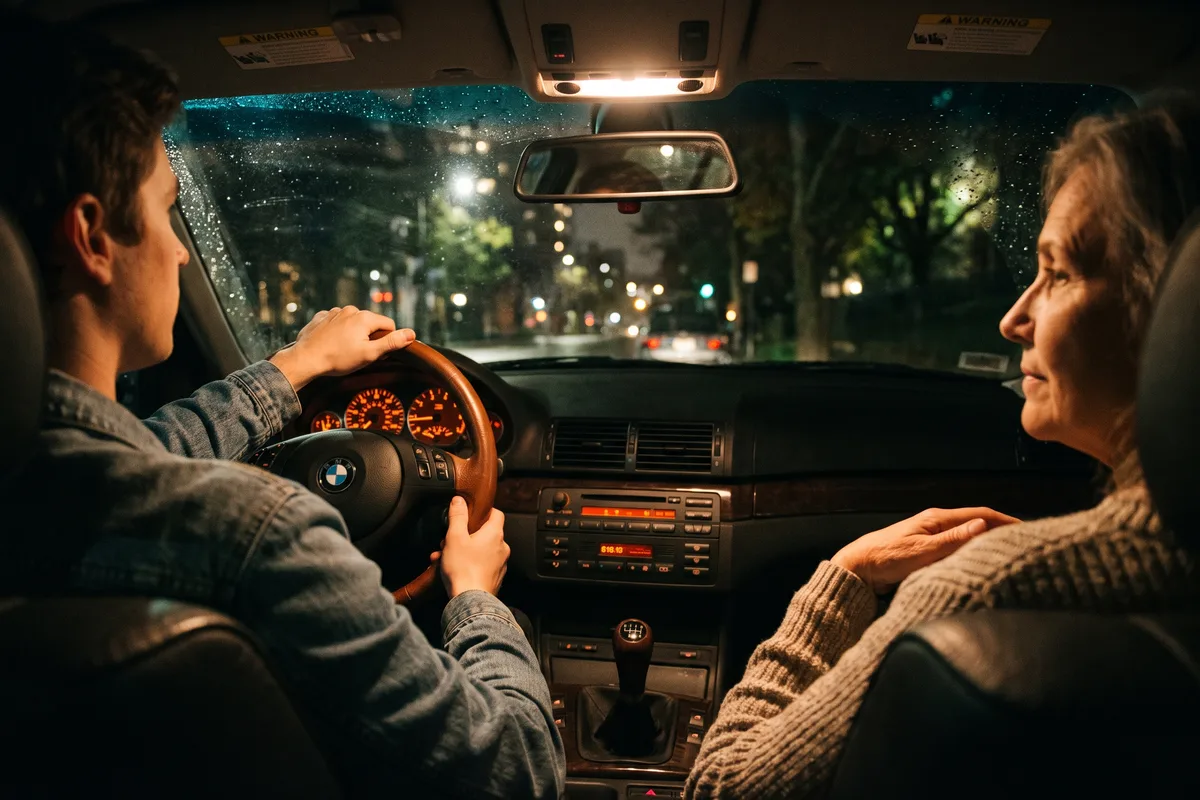
That is not an argument for banning night driving. It has to be learned, and the only way to learn it is to do it. It is an argument for learning it deliberately, with a parent in the passenger seat first, and with a small number of rules everyone actually agreed to.
One rule to start with, because it makes the rest easier to accept: **rules that are negotiated get followed, and rules that are announced get worked around.** Everything below is written to be discussed at a kitchen table rather than issued from one.
Why night driving is genuinely harder
It is worth explaining the reasons rather than just stating the risk, because a teenager who understands the mechanism drives differently from one who has been told to be careful.
- You can see less, and later. Headlights on low beam light a limited stretch of road, and at speed a hazard can appear inside the distance you need to stop. This is the single biggest change from daytime driving.
- Depth and speed are harder to judge. Working out how fast an oncoming car is closing is much harder from two points of light than from a whole vehicle in daylight.
- Glare costs you seconds. Eyes recover slowly after oncoming headlights, and on a dark road those seconds are the ones you needed.
- Fatigue arrives quietly. Late evening, after a shift, after sport, after a long day of school. Tiredness degrades reaction time and judgement before anyone feels sleepy.
- The mix of other drivers changes. Late at night there are proportionally more impaired and more tired drivers around, and a new driver has less experience predicting erratic behaviour.
None of that is a reason to be frightened. It is a reason to reduce the number of hard things happening at once, which is what the rules below try to do.
Six one sentence family rules
Keep the list short enough to remember while driving. Six is about the limit. Write them down, put them on the fridge, and agree them together rather than handing them over.
The rules worth agreeing
- Passengers: for the first stretch of night driving, drive alone or with one agreed passenger, because a full car is the loudest possible classroom.
- Curfew: agree a time together, and agree it can move for a good reason if you are asked in advance rather than after the fact.
- Arrival check-in: every trip ends with a check-in, and an automatic arrival alert counts, so nobody has to touch a phone.
- Phone: the phone is mounted, silenced and untouched from before the engine starts until after it stops, with no exceptions for a quick reply.
- Tired means stop: if you are too tired to drive you call for a lift, and there will be no argument about it that night.
- No consequences call: if anything at all makes driving unsafe, you call, and the conversation about it happens tomorrow, not on the phone.
That last one is the most important, and it only works if you honour it exactly once when it is inconvenient. A no consequences call that comes with a lecture is not a no consequences call, and your teenager will price that in for the rest of their driving life.
On curfews and the law
Graduated licensing systems in many countries restrict night driving and passengers for new drivers, and the specifics differ enormously by region, including the times, the passenger limits and the length of the restriction. Look up the rules where you live and treat them as the floor rather than the ceiling. Your family agreement can be stricter than the law, and often should be during the first months.
Practise at night before they drive at night alone
Most learner hours happen in daylight, for the sensible reason that daylight is when people have time. That leaves a gap, and the gap gets filled on a Friday night with friends in the car. Close it on purpose.
- 1Start on a quiet road you both know well, so the only new variable is the darkness rather than the route.
- 2Practise the headlight routine. Main beam on an empty road, dipped for oncoming traffic, and looking to the left verge rather than into the glare.
- 3Rehearse the drive they will actually do. The route to work, to a friend's house, home from practice. Familiar geography reduces the load enormously.
- 4Do one wet night if you can manage it safely, because rain at night changes everything about how the road reads.
- 5Practise parking and reversing in the dark, which is where most low speed knocks happen and where confidence is easy to build.
- 6Try one motorway or dual carriageway stretch at night with you present, before they meet one alone.
Our guide to practice drives with your learner teen has the structure for these sessions, including how to give feedback without turning the car into a courtroom. The night version follows the same shape, just with fewer trips and more debriefing afterwards.
The goal of the first solo night drive is that nothing about it is new except your absence.
Be Closer shows your whole family on one private map, free to start.
Consent-first, never sold, and gentle on your battery. iOS and Android.
How arrival alerts remove the texting
Here is the part parents underrate. The most common way a phone gets picked up in a moving car is not social media. It is a parent asking where are you, and a teenager who does not want to worry them answering.
An arrival alert removes the whole exchange. Set a notification for home, for work and for wherever the regular late trip ends, and the phone tells you they arrived without anyone touching anything. Be Closer does this on the family map, works on iPhone and Android, is free to download and holds 4.4 stars from over 150,000 ratings across the App Store and Google Play. The mechanism matters more than the brand: automate the check-in and you delete the reason to text.
- Set alerts for arrivals, not for every movement, so the notifications stay meaningful.
- Tell your teen exactly which alerts exist, because a surprise notification feels like surveillance and an agreed one feels like a system.
- Agree that you will not call unless something is genuinely wrong, and then keep to it.
- Keep a charging cable in the car, because a dead phone breaks the whole arrangement and causes the exact worry you were trying to avoid.
If you want the detail of how driving alerts work and what they can reasonably tell you, we cover it in how driving safety alerts work. The short version is that they are good at arrivals and at unusual events, and much weaker as a general report card.
The five minute debrief
After the first few solo night drives, ask three questions and then stop talking. What was harder than you expected, what surprised you, and what would you do differently next time. Keep it short, keep it curious, and resist the urge to add a lesson at the end. A teenager who reports honestly is worth far more than a teenager who reports well, and the difference is entirely in how you respond to the first awkward answer.
It also helps to name the specific situations they have not met yet, so the first encounter is not a surprise. Roadworks with temporary lights at midnight, a tailgater with full beams on, a deer or a fox at the edge of the road, a stretch with no white lines. Talking each one through in the kitchen costs nothing and gives them a plan to reach for at the moment they need one.
The honest limits
I would rather say this plainly than let an app carry expectations it cannot meet.
- No app can see fatigue. A tired driver looks identical to a rested one on a map, and fatigue is one of the largest night risks. Only a conversation and a genuine permission to stop can address it.
- No app can see who is in the car, which is why the passenger rule has to be an agreement rather than a setting.
- Location accuracy varies. It can reach up to 95% accuracy in good conditions and degrade in tunnels, car parks and dense cities, so treat an odd looking route as a question.
- Alerts do not prevent anything. They tell you what happened. Prevention happens in the practice hours and in the rules you agreed.
So the plan is human first and technical second: agreed rules, deliberate night practice, an honest no consequences call, and automation only for the boring part, which is letting people know you got there. When the first solo night drive comes, our first solo drive protocol is a good final checklist to run through together before they take the keys.
Frequently asked questions

Daniel covers privacy, consent and the technology under the hood. A dad who reads the settings screens so you don't have to, he believes the best family tech is the kind you can explain to your kid in one sentence, and that nothing should ever be tracked in secret.
Our guides are written by Be Closer's editorial voices and reviewed by the team behind the app. Questions? support@becloser.com
Published · Updated