 Driving
Practice drives with your learner teen: a calm, repeatable structure
Structure beats volume. Climb a fixed ladder of environments, from an empty parking lot to night and rain, and only move up when the current rung is boring. Keep your own commentary to a short list of rules, debrief for five minutes afterwards, and end sessions early rather than late.
The first practice drive I supervised lasted eleven minutes and I talked for roughly nine of them. Nothing went wrong. Nothing was learned either, because a person cannot process a running commentary and a roundabout at the same time.
What follows is the structure I wish I had used from the start. It is not a curriculum, and it does not replace whatever professional instruction and legal requirements apply where you live, which you should check first. It is the shape of the hours in between, the ones you supervise, which are where most of the actual driving happens.
The premise is simple. Skill comes from repetition in conditions slightly harder than comfortable, and it comes fastest when the learner is calm enough to notice what they are doing. Your main job is not instruction. It is keeping the temperature low enough for learning to happen.
Why ad hoc practice underperforms
Most families practice by combining it with an errand. Drive to the shops, drive to training, drive to your grandmother's. It is efficient and it is better than nothing, and it has three quiet costs.
- The route decides the lesson. Whatever the traffic offers is what gets practiced, which means the difficult things get practiced rarely and by accident.
- There is a deadline. Arriving on time and learning to drive pull in opposite directions, and the deadline usually wins. Pressure is the enemy of a learner's judgment.
- Nobody reviews it. The drive ends, everyone gets out, and the useful five minutes never happens.
One sentence rule: a practice drive has a goal and no destination.
Combined trips still count. Just make sure a decent share of hours are deliberate ones, where the only purpose is to practice one named thing.
The route ladder
Six rungs, climbed in order. The rule for moving up is not a number of hours. It is that the current rung has become boring, which is the most reliable signal that a skill is automatic.
Rung 1: the empty lot
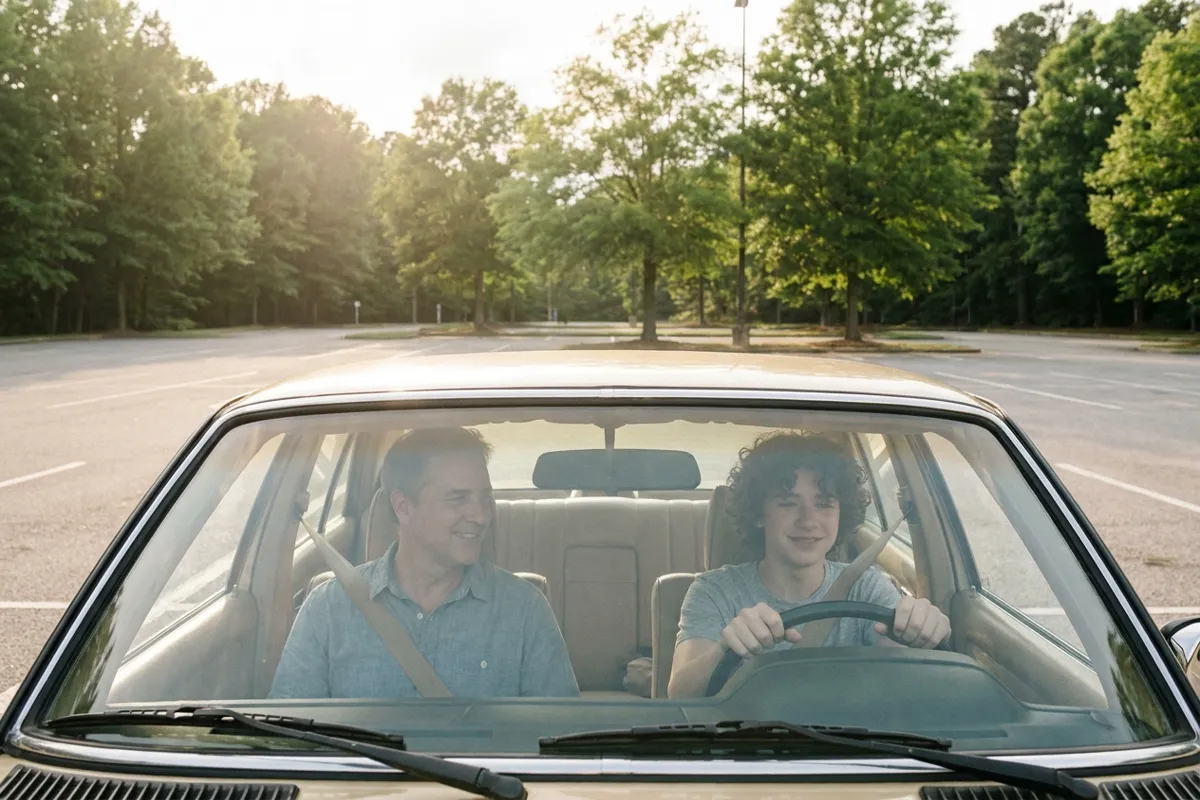
A large empty car park on a Sunday morning. Nothing to hit, nothing to hold up. This is where the car itself gets learned: smooth starts, braking to a stop that does not nod the passengers, steering to a mark, reversing, parking between two painted lines. Do this for longer than feels necessary. Every later rung is easier when the controls have stopped requiring attention.
Rung 2: quiet residential streets
Low speeds, real edges, parked cars, junctions, pedestrians who step out. The goal here is scanning rather than speed. Ask them to say out loud what they are checking. Commentary driving sounds odd for about four minutes and then becomes the most useful teaching tool you have.
Rung 3: busier arterial roads
Multiple lanes, traffic lights, lane discipline, keeping a gap in moving traffic, merging. This is the first rung where other drivers behave impatiently, so it is also where you find out how your learner responds to pressure. Watch that more closely than you watch their lane position.
Rung 4: highways and fast roads
Joining, keeping a following distance that would look excessive to a confident adult, reading signs early, leaving at the right exit calmly. Plan the route in advance and describe it before you set off, so their attention goes to the driving rather than the navigation.
Rung 5: night
Repeat rungs two and three in the dark. Everything familiar becomes unfamiliar: judging distance, reading the road surface, coping with headlights. Because the environment is known, the only new variable is the light, which is exactly how you want to introduce difficulty.
Rung 6: rain and poor conditions
Deliberately go out in bad weather with an adult beside them, so the first time is not alone. Longer braking distances, worse visibility, standing water. Keep the route easy and the speeds modest. The lesson is respect for conditions, not skill at the limit.
Rules for climbing the ladder
- Move up when the current rung is boring, not when the calendar says so.
- Drop a rung for a session after anything that shook either of you. It is a reset, not a punishment.
- Name one goal per session and say it before the engine starts.
- Repeat the same route several times. Familiarity frees up attention for judgment.
- Keep sessions to roughly forty five minutes. Concentration fades before enthusiasm does.
One sentence rules for the passenger parent
You have the harder seat. You can see everything and control nothing, and your instinct to narrate is strong. These are the rules I hold myself to, written as sentences so I can actually remember them mid drive.
- Say the instruction before the junction, not during it. Late instructions cause the mistake you were trying to prevent.
- One thing at a time. Pick the session goal and let the smaller errors go until the debrief.
- Use direction, not evaluation. Say slow down now, not why are you going so fast.
- Keep your hands and feet still. Grabbing the handle or bracing teaches fear rather than technique.
- Volume down means calm down, yours first. If your voice rises, the lesson has already stopped.
- Silence is allowed. Two quiet minutes on a straight road is not wasted time.
- Praise the specific thing. That was a good gap you left is worth more than well done.
If a moment genuinely requires intervention, use a short agreed phrase decided in advance, such as stop now or pull over. Agree it before the first drive so it is never confused with ordinary conversation.
The passenger's job is to keep the car safe and the learner calm. Everything else is for afterwards.
Be Closer shows your whole family on one private map, free to start.
Consent-first, never sold, and gentle on your battery. iOS and Android.
The five minute debrief
This is the part families skip and it is the part that compounds. Do it in the car, engine off, before anyone goes inside. Same three questions every time.
- 1What went well? They answer first. Let them find it, even if it takes a moment.
- 2What was hardest? Usually not what you would have guessed, which is the point of asking.
- 3What do we practice next time? One thing. Write it in a note on your phone so the next session has a goal already.
Two habits make this work. Keep your own additions to one item, so the debrief stays a conversation rather than a report. And end on something they did well, because the feeling they carry into the next drive matters more than the detail they remember.
What driving data can and cannot tell you
Driving features in family apps, and telematics generally, record things like speed relative to the limit, harsh braking, rapid acceleration, and phone handling while moving. Used well, they are genuinely useful for a learner, because they replace argument with a record.
- They settle disputes cheaply. Whether that stop was as abrupt as it felt is now a fact rather than an opinion.
- They show patterns. Three hard brakes at the same junction every week is a real finding, and a route to practice.
- They shift the tone. Reviewing a summary together is calmer than a correction delivered at speed.
Now the honest half. A drive log cannot measure judgment. It does not know that the hard brake was correct because a child stepped out, or that the smooth, unremarkable drive involved following too closely for twenty minutes. It records inputs, not decisions.
So use it as a discussion prompt and never as a scoreboard. Two conditions make the difference between a tool that helps and one that breeds resentment: your teen knows exactly what is recorded, and they see the same data you do. Anything monitored in secret damages the trust that safe driving actually rests on. If you want the mechanics of what these features detect, we set it out in how driving safety alerts work.
Reviewing a drive together
- Look at it side by side, not separately then confronted.
- Ask what happened there before you say anything about it.
- Accept good explanations. Sometimes the sensible action registers as an event.
- Pick one pattern to work on, not five incidents to defend.
- Review weekly rather than after every trip. Constant scrutiny stops being feedback.
Knowing when to end a session
The last ten minutes of a long practice drive are usually the worst ten minutes, and they are the ones people remember. End early and deliberately.
- End on a success. When something goes well and the mood is good, that is the moment to head home, not to try one more thing.
- End when either of you is tired. Tired learners make errors that teach nothing, and tired supervisors get sharp.
- End after a scare. Pull over, sit for a minute, and drive home yourself if that is what is needed. No lesson lands in the ten minutes after adrenaline.
- End when the goal is met. If today was reversing into a bay and it is now reliable, the session is complete. Twenty more minutes of general driving is not a bonus.
Over a few months this structure produces something better than confidence, which is calibration: a driver who knows which conditions they have earned and which they have not. That is the quality that matters on the first drive without you in the car, and when that day comes, the first solo drive protocol is a good thing to read together the evening before.
Frequently asked questions

Daniel covers privacy, consent and the technology under the hood. A dad who reads the settings screens so you don't have to, he believes the best family tech is the kind you can explain to your kid in one sentence, and that nothing should ever be tracked in secret.
Our guides are written by Be Closer's editorial voices and reviewed by the team behind the app. Questions? support@becloser.com
Published · Updated