
 Pets
PetsWhen a Family Pet Dies: Helping Your Children Through It
Tell children the truth in plain words, using died rather than went to sleep or went to live on a farm, and answer the questions they actually ask. Let them grieve in their own way, including drawing, a small goodbye or a box of photographs, and expect the empty spaces around the house to hurt for weeks. Let your own sadness show, and leave the question of another pet until the family arrives there together.
The dog died on a Sunday. My neighbour told her six year old that Bess had gone to sleep, because that was the kindest sentence she could find at eight in the morning with her own eyes streaming. For the next three weeks her daughter fought bedtime with a determination nobody could explain, until she asked, from under the duvet, whether people who go to sleep always come back.
That is the whole difficulty in one story. The words we reach for to soften a death are the words that confuse a child, and children work with what they are given. They are also, usually, tougher than we expect. What frightens them is not the truth. It is being alone with a version of events that does not add up.
This guide is about the first weeks after a family pet dies. What to say, how differently it lands at different ages, how to let children grieve in their own strange and practical ways, and what to do with the bowl by the back door that nobody can bear to move.
Tell them the truth, in plain words
Use the word died. It sounds harsh written down and it is the kindest thing you can do, because it is the only word that cannot be misread. Bess died this morning. Her body stopped working and it will not start again. She is not in any pain now.
The gentler phrases cause real trouble. Went to sleep attaches death to bedtime, which is where a child is least able to cope with it. Put to sleep needs unpacking honestly if you use it at all, because a child who hears it and later works it out on their own can feel deceived at the worst possible moment. Ran away or went to live on a farm is the hardest of all: it leaves a child waiting, watching the gate, and sometimes quietly blaming themselves for the leaving.
Children can carry sad news. What they cannot carry is a story that keeps changing.
- Say it early. Before they hear it from a sibling, a neighbour, or your face across the kitchen.
- Say it simply. Two or three short sentences, then stop and let them react.
- Answer what is asked. Not the bigger question you assume is underneath it.
- It is fine to say you do not know. Where she is now is a question you are allowed to answer honestly, including that different people believe different things.
- Expect to repeat it. Children ask the same question for weeks. Each time is a new attempt to make it real, not forgetfulness.
If the death was a decision made at the vet, say so in ordinary language: she was very ill and would not have got better, so the vet helped her die gently and we were with her. Children handle that far better than adults expect, and it protects them from later discovering that the story had a missing piece.
The same news lands differently at different ages
Understanding of death builds gradually, and children move at their own pace. These are rough everyday patterns rather than rules, and you know your own child better than any list does.
Toddlers and preschoolers
Very young children often do not grasp that death is permanent. They may ask when the cat is coming back, several times, cheerfully. That is not coldness and it does not mean they did not love him. Keep answers short and consistent, expect the question to return, and watch for the grief showing up sideways in sleep, clinginess or play rather than in words.
Primary school age
This is often where it lands hardest, because the permanence is understood and the feelings arrive with it. Children this age tend to be intensely practical and sometimes startlingly blunt. They want to know what happens to the body, whether it hurt, whether it was somebody's fault, and often whether it was theirs. Answer the mechanics plainly, and say clearly and more than once that nobody caused this, especially if the last person to walk the dog was them.
Teenagers
Teenagers may say almost nothing and grieve enormously. The pet was often the one member of the household that made no demands, and its death can land in the middle of a year that was already difficult. Do not force conversation. Be around, be sad in front of them, and let the talking happen sideways in a car or a kitchen at eleven at night.
Worth a gentle extra eye
- A child insisting it was their fault weeks after you have said it was not.
- Sleep, appetite or school changes that settle in rather than pass.
- No reaction at all in a child who was very attached, especially an older one.
- Fear about other family members dying that starts to shape the day.
- If any of that worries you, talk to your doctor or the school. Asking is never an overreaction.
Let them grieve their own way
Children grieve in bursts. A child can sob for ten minutes and then ask what is for tea, and both of those are real. Adults sometimes read the second half as proof that it is over, and then feel ambushed a fortnight later when it surfaces again in the middle of a supermarket.
What helps most is something to do. Grief in children is practical, and a task gives the feeling somewhere to go.
- 1A goodbye of some kind. A few minutes in the garden, everyone saying one thing they liked about him. Small and homemade beats formal.
- 2A drawing or a letter. Even from a child who cannot write yet, dictated to you. This is often where the real feelings turn up.
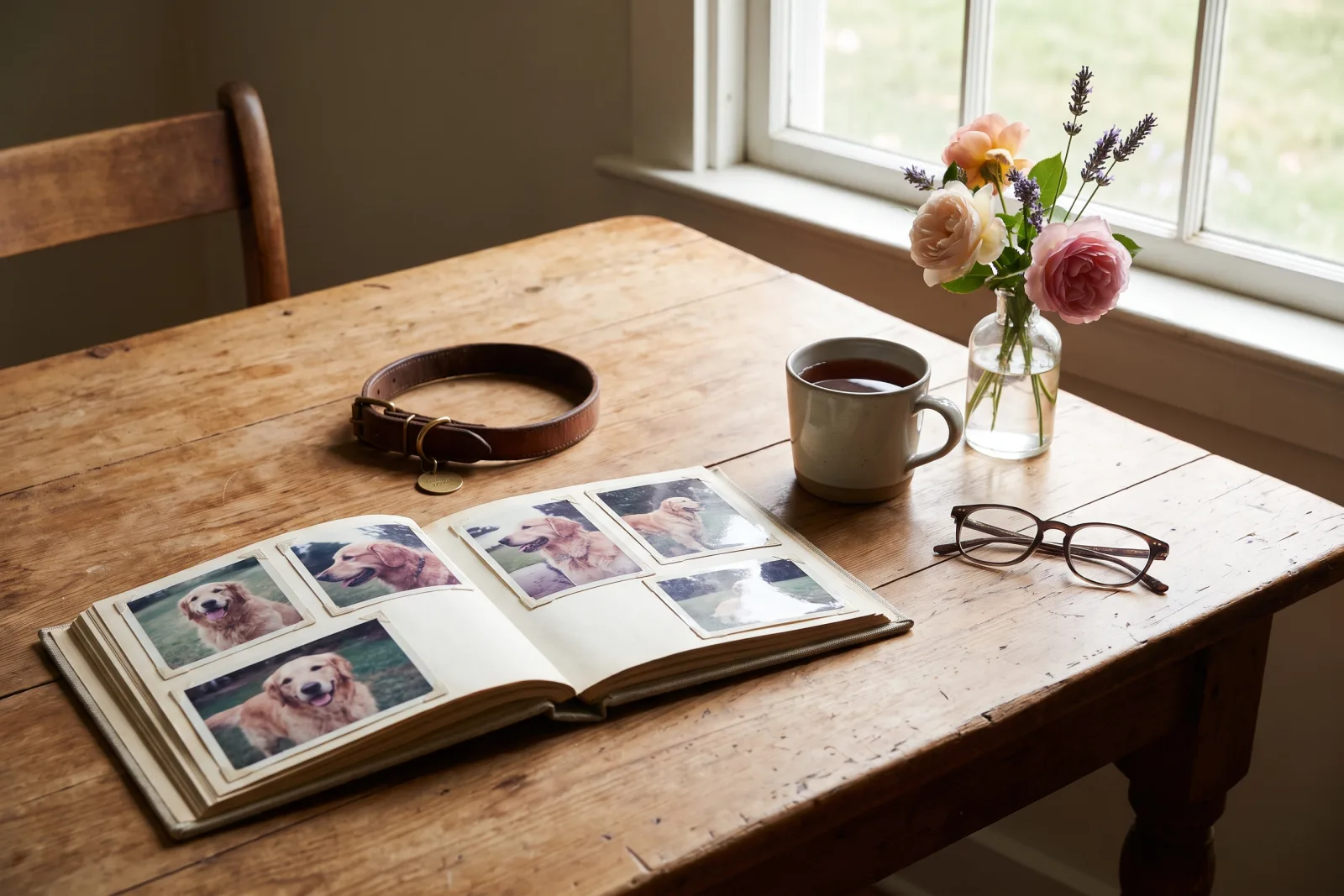
- 3The shoebox. Photographs, the collar, the chewed toy, the tag. Somewhere in the house, not the loft.
- 4A plant or a stone. Something outside with a name on it that they can visit on a bad day.
- 5Telling the story. Encourage the funny ones. The time he ate the birthday cake matters as much as the last week.
Do not insist on any of it. A child who does not want to draw a picture is not doing grief wrong. Offer, leave the materials out, and let them come to it when they are ready, which may be a month later on an ordinary Tuesday.
Be Closer shows your whole family on one private map, free to start.
Consent-first, never sold, and gentle on your battery. iOS and Android.
The empty spaces
Nobody warns you about the objects. The bowl by the back door. The lead on the hook. The particular silence at half past four when a dog would have started watching the window. A house that has held an animal for ten years is shaped around it, and the shape stays behind.
Do not clear everything on the first afternoon. It is done with the best intentions, usually to spare the children, and it can feel to them like the animal has been deleted. Equally, do not leave a full bowl of food out for a fortnight. Somewhere between the two is a family conversation, and children should be in it.
- Ask before you move things. Even a five year old can have an opinion about the collar.
- Keep one or two things out. A photograph on the shelf, the collar in the box. Continuing evidence that he existed.
- Warn them about the routines. The empty walk after school, the first Saturday morning, the vet's reminder letter that arrives anyway.
- Tell school. A quiet word means a teacher understands the child who is somewhere else on Monday.
- Expect ambush days. Finding a toy under the sofa in March undoes people. That is normal and it passes.
This is the week when the family map matters less than the family table. Sit down together more than you strictly need to. Cook something everyone likes. The most useful thing you can offer a grieving child is the ordinary rhythm of a household that has not stopped.
Another pet, and your own grief
Somebody will suggest a puppy within the week, usually kindly. Try not to move quickly. A new animal brought in to stop children crying carries an impossible job, and children sense the substitution immediately. Some will refuse to love it. Others will feel guilty for loving it.
There is no correct interval. Some families need months, some need a year, and a few genuinely do better with a house that is not silent. What matters is that the decision arrives together, out of wanting another animal rather than out of wanting the sadness to stop, and that the new one is allowed to be entirely itself with its own name and its own habits. When you do get there, our guide on whether your family is ready for a dog is worth reading with fresh eyes, and bringing home a rescue dog covers the first fortnight.
One last thing, and it is the one I would keep if I could only keep one. Let your children see you cry. Parents work hard to hold it together in front of children, believing that composure is protection. What it actually teaches is that big feelings are things you hide, and that lesson lasts much longer than a week of sadness would have.
Say it plainly. I loved him too and I am very sad today. Then make the tea, and let the house be quiet for a while. Grief shared inside a family is the first real lesson a child gets in how to survive losing someone, and doing it together is what makes the next one bearable.
Frequently asked questions

Priya writes about the family members we care for at every age, parents living alone, dogs that bolt at squirrels, and the quiet worry in between. She writes the way she checks in: gently, and always dignity first.
Our guides are written by Be Closer's editorial voices and reviewed by the team behind the app. Questions? support@becloser.com
Published · Updated