 Driving
Phones in the car: family rules that actually prevent distracted driving
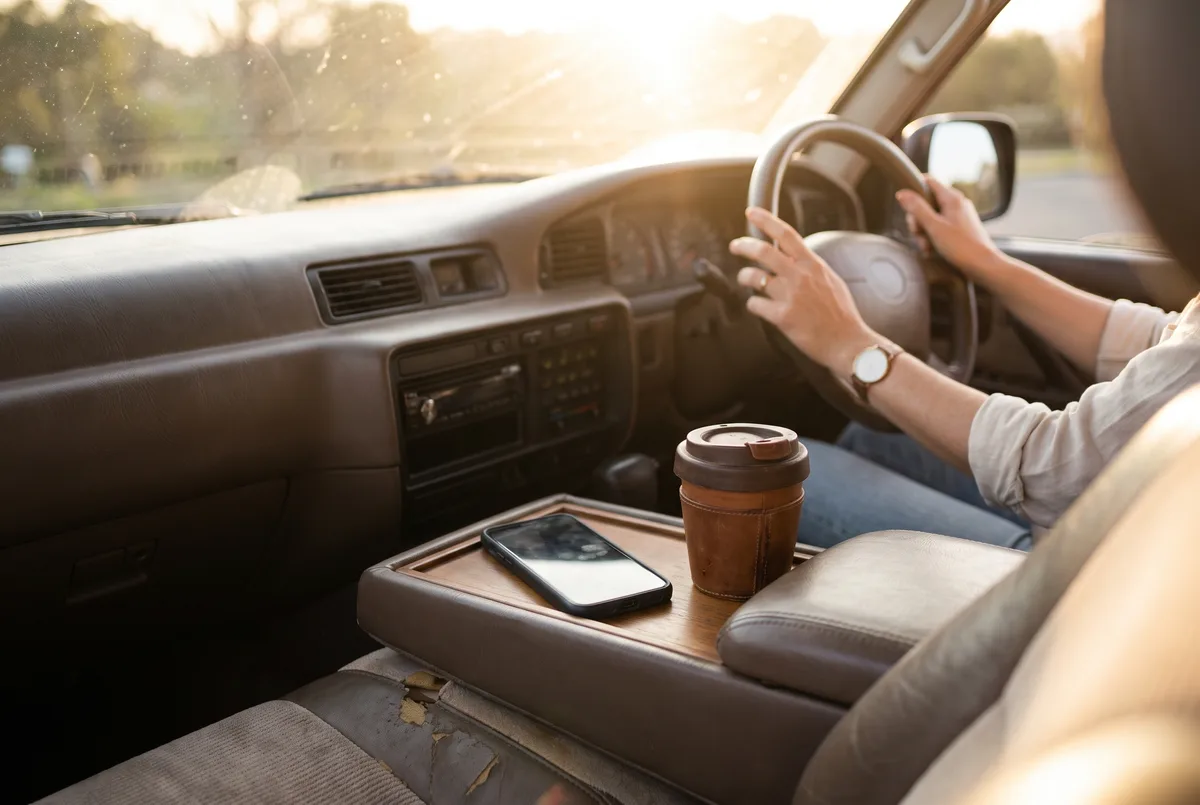
The rule that works is short enough to say in one breath and identical for everyone in the family: the phone rides in the tray, face down, every trip. Do Not Disturb while driving with an auto reply removes most of the temptation, and arrival alerts remove the main reason anyone texts a moving driver in the first place.
There is no shortage of awareness about phones and driving. Ask any teenager whether texting behind the wheel is dangerous and you will get the correct answer, delivered with mild impatience at being asked. Awareness is not the problem.
The problem is that a buzzing phone in a cupholder at a red light is a small, specific temptation, and rules that are long, conditional or aimed only at the youngest driver in the house lose to it. What survives is a rule short enough to repeat without thinking, applied to everyone, backed by a couple of settings and one habit that removes the reason for the interruption entirely.
This guide is that setup. It is deliberately dull, because dull is what gets followed on the fortieth trip.
Why glances are the risk that dwarfs the others
Driving is a task where your eyes are doing continuous work. Speed, position, the gap ahead, the movement at the edges: all of it is being sampled constantly and most of it below the level of conscious thought. A glance away does not pause that work, it blanks it, and the car keeps going.
That is the whole mechanism, and it explains why the usual arguments miss. Hands free is better than handheld but does not restore the eyes. A quick look is quicker than a reply but still a blank interval. And the most dangerous glance is not the deliberate one on an empty road, it is the reflex one when something changes ahead and your attention happens to be in the wrong place.
You cannot look at a phone and at the road. You can only alternate, and the road does not wait its turn.
It is worth being specific about what counts as a glance, because people underestimate it. Reading a notification banner is a glance. Checking who is calling is a glance. Skipping a track, dismissing a map prompt, glancing at the time on a screen that is not the dashboard: all glances. The activity that feels harmless because it took a second is precisely the one that happens most often, and frequency is what turns a small risk into a real one.
Which gives the design goal for any family rule: not "be careful with your phone", but "make the phone impossible to glance at without a deliberate decision". Distance and orientation do more than willpower.
One-sentence rules that survive real trips
I am a firm believer in rules you can say in one breath, because those are the ones people actually recall in the moment. Long policies with exceptions get replaced by improvisation the first time they are inconvenient.
- The phone rides in the tray, face down, every trip. Not the lap, not the cupholder screen up, not wedged by the gearstick. One location, one orientation, no thinking required.
- If it needs an answer, it needs a parking space. This covers calls, texts and the sudden urge to check something. Pulling over is always allowed and never criticised.
- Set the route before you set off. Navigation is not an exception to the rule, it is a thing you finish while stationary.
- Passengers own the phone. If someone else is in the car, they handle messages, music and directions. The driver's phone stays put.
- Red lights are not free. This is the one that catches everyone, and it is the one worth saying out loud most often, because a light changing while your eyes are down is one of the most common ways an ordinary trip turns into a near miss.
Pick two or three of these, not all five. A rule set that is short enough to remember beats a complete one that nobody can recite. For newer drivers, these sit neatly alongside the wider agreements in a first solo drive protocol.
Do Not Disturb while driving, and auto-replies
Both major phone platforms have a driving mode that silences notifications while the car is moving. It is one of the genuinely good phone features, and it is chronically underused because the setup takes two minutes that nobody has spare.
- 1Turn it on and set it to activate automatically. Automatic detection, usually via motion or a car's Bluetooth connection, is the whole point. A mode you have to remember to enable is a mode you will forget on the day it matters.
- 2Write the auto reply yourself. Something plain like "Driving, will reply when I stop" tells the sender that silence is expected rather than worrying.
- 3Allow a small set of exceptions. Most implementations let repeated calls from the same number ring through. That is usually the right balance for a genuine emergency.
- 4Set it up on every phone in the family, on the same afternoon. Including the adults, especially the adults.
The auto reply matters more than it looks. A large share of driver phone use is not initiating anything, it is answering a message that arrived and feels urgent because it is unanswered. A reply that has already gone out, unread by the driver, defuses that pressure at both ends.
Be Closer shows your whole family on one private map, free to start.
Consent-first, never sold, and gentle on your battery. iOS and Android.
How parents model the rule
Children have been watching your driving since they were rear facing, and they are considerably better at noticing what you do than what you say. A teenager who has watched a parent check messages at every red light for a decade has already learned the family rule, and it is not the one on the fridge.
What kids in the back seat actually notice
- Where your phone lives during a trip. Tray or lap is the whole lesson.
- What you do when it buzzes. Ignoring it visibly teaches more than a conversation later.
- Whether red lights count. This is the specific exception children spot instantly.
- Whether you say it out loud. "That can wait" as you pull away costs nothing and lands permanently.
There is a fair exchange available here too. Ask your teenagers to call you out when you break the rule. It converts an instruction into a shared standard, and it is remarkably effective, largely because they enjoy it enormously.
The passenger-as-navigator role
Giving passengers an explicit job is the easiest win in this whole guide. Left undefined, a passenger is a source of distraction. Defined, they are the reason the driver never has to touch a screen.
- Navigation. Route changes, junction warnings, working out which lane. Spoken, not handed over on a screen.
- Messages. Reading anything genuinely urgent aloud and replying on the driver's behalf.
- Music and climate. Small, endless, and exactly the sort of thing that pulls eyes downward.
- Timing. Sending the "we are twenty minutes away" message so nobody at the other end needs to ask.
This works well with young drivers carrying friends, where the social pressure of a silent phone is real. A named navigator gives the group something structured to do with the device instead. It pairs well with the wider constraints in night driving rules for teens and the graduated approach in practice drives with your learner.
Removing the reason for the message in the first place
Here is the part families skip. Most texts sent to moving drivers are not conversation. They are a single question, asked by somebody at the other end who is mildly anxious: where are you.
If that question is already answered, the message never gets sent, the phone never buzzes, and no rule has to hold. That is a far more reliable fix than discipline. Arrival notifications in Be Closer do exactly this: the person waiting gets told when the car reaches home, school or work, so they stop reaching for their phone to check. A shared map does the same job for the middle of the journey, and the Drive tracker covers the car itself rather than whoever happens to be carrying a phone inside it.
| The old habit | What replaces it | Who stops worrying |
|---|---|---|
| "Are you nearly here?" text | Arrival alert when the car pulls in | The person waiting |
| Driver replying at a red light | Auto reply sent automatically | Both of them |
| Calling to check a late arrival | A glance at the shared map | The person waiting |
| Wondering where the car is | Drive tracker on the vehicle | Everyone in the circle |
None of this is a substitute for the rule about where the phone rides. It is the thing that makes the rule easy to keep, which in practice is the difference between a policy and a habit. Be Closer is free to download and used across more than 10 million downloads, but the useful bit here is small and specific: fewer reasons for a phone to buzz at a driver.
Frequently asked questions

Daniel covers privacy, consent and the technology under the hood. A dad who reads the settings screens so you don't have to, he believes the best family tech is the kind you can explain to your kid in one sentence, and that nothing should ever be tracked in secret.
Our guides are written by Be Closer's editorial voices and reviewed by the team behind the app. Questions? support@becloser.com
Published · Updated