 Aging Parents
When Grandparents Babysit: A Kind Safety Handoff for Both Generations
Write one page rather than delivering a speech: routines, allergies, medicines, and the numbers. Frame anything that has changed since they raised you as new guidance rather than a correction, prepare the house for a toddler and an older adult at the same time, agree what happens if something goes wrong, and then leave them alone for the evening. Arrival alerts and a shared map do the job that hourly texting does, without the implication.
The first time my parents kept my daughter overnight, I wrote four pages. Four. I laminated the first one. My mother read it standing in her own hallway, with the child who had raised me looking back at her from the bottom of a very long list, and she said, kindly, that she had managed me for eighteen years without a laminator.
She was right and I was right, which is the difficulty with this whole subject. She raised three children competently. She also had never heard of the sleep guidance my daughter's health visitor had given us six weeks earlier, because that guidance did not exist in 1978. Both things are true, and the entire art of a grandparent handoff is holding them at once without anybody feeling insulted.
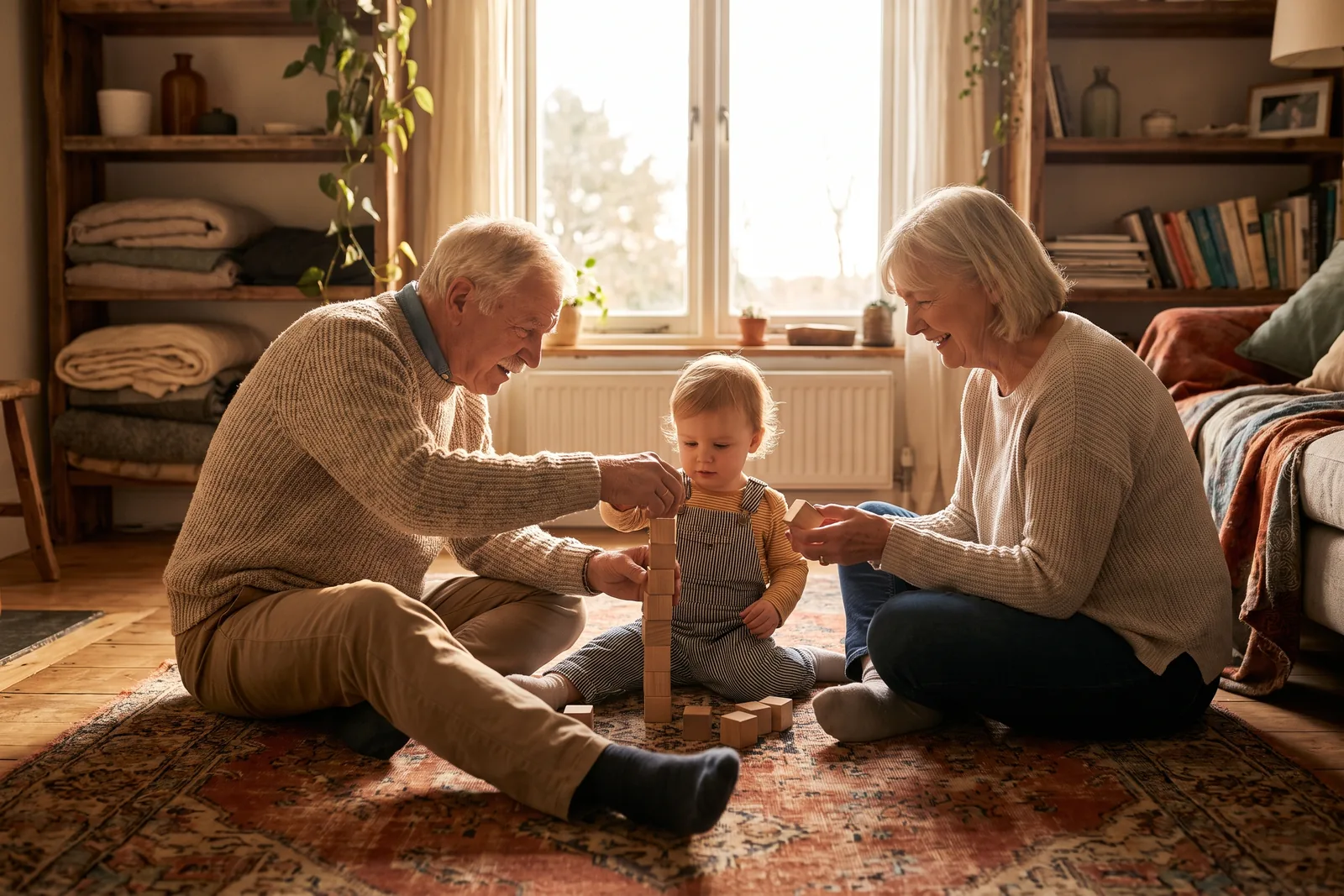
This is a guide to doing that gently. It assumes two people who love the same child and are slightly nervous about each other, which is most families. It also assumes something people rarely say out loud: the handoff has to work for the grandparent as well as the child, because a seventy five year old on a hard floor with a toddler is a person with needs of their own.
One page, not four
Write it once, keep it on the fridge at their house, and update it rather than rewriting it each time. A single page gets read. Four pages get skimmed and resented.
What belongs on the page
- The rhythm of the evening: meal, bath, story, bed, and roughly when.
- Allergies and medicines, in bold at the top, with doses written out and the time of the last one given.
- Foods and drinks that are a no at the moment, without the essay explaining why.
- How your child settles, including the specific words, the specific toy, and what a normal amount of protest sounds like.
- Numbers: both parents, where you will be, one nearby friend or neighbour, and the doctor or out of hours service.
- One line on what you do not mind at all, such as extra biscuits or a late bedtime. This is the line that makes the rest of the page feel like information rather than instruction.
That last item does more work than everything above it. A handoff sheet made only of prohibitions reads as a low opinion. One that grants something reads as trust.
Updating the norms without saying you got it wrong
Some advice has genuinely changed since your parents were raising children. Sleep position, car seats, weaning, choking, sun. None of it is a comment on their parenting, and all of it can sound like one.
The reliable trick is to put the guidance somewhere outside your relationship. Not you should, but this is what they tell us now. Blame the leaflet, never the grandparent.
- "The health visitor was very firm about this one, so we follow it even though it sounds fussy."
- "Apparently the advice changed a few years ago, which I only found out myself last month."
- "You will laugh, the rules on this are the opposite of what they were."
- "I know it is different from how we did it. It makes me feel better, so humour me."
Pick your two or three non negotiables and let the rest go. Car seats, sleep and medicines are worth being immovable about. Whether the biscuit came before or after the bath is not, and defending it will cost you the goodwill you need for the ones that matter.
Choose the two rules you will be firm about. Give away everything else generously, and say so out loud.
Preparing the house for a toddler and a grandparent at once
Everyone childproofs. Very few families think about the other half of the room, which is that the person in charge may not be able to get up quickly off a low sofa, may not hear a quiet child, and may be managing their own knees or eyesight.
- 1Set up a play space where the grandparent can sit in a chair at a comfortable height rather than on the floor for two hours.
- 2Clear the trip hazards for both of them: the toy in the doorway is as dangerous as the loose rug.
- 3Make sure the lighting is good in the hallway and on the stairs, and leave a night light on.
- 4Bring everything needed to one level if stairs are difficult, including nappies, spare clothes and drinks.
- 5Put your child's changing or feeding station at a height that does not require bending or lifting from the floor.
- 6Leave the door locked and the key in a known place, so nobody is searching in a hurry.
Ask directly what would make the evening easier for them, and take the answer seriously. My father, who would never have said the word tired, once mentioned in passing that the bath was the hard part. We started bathing her before we left. He kept babysitting for another six years.
If mobility or memory has been changing, that is a bigger conversation than one evening of childcare, and it is handled with more care in signs your aging parent needs more help.
Be Closer shows your whole family on one private map, free to start.
Consent-first, never sold, and gentle on your battery. iOS and Android.
The plan if something goes wrong
Agree this once, calmly, in daylight, and then never rehearse it again. A grandparent who knows exactly what to do does not need to phone you to ask permission, and permission is the thing they most fear needing.
Agree in advance
- They do not need to ask us first. If it is urgent, call the emergency number, then call us.
- Small injuries are not a phone call. Bumped heads, grazes and a bad tantrum can wait for the doorstep.
- A named nearby adult who can be there in five minutes, with the grandparent's permission to call them.
- Where the paperwork lives, such as the child's red book, the medicine and the doctor's details.
- We will always answer. Say it plainly, and then actually keep the phone in your hand.
Say the sentence that matters out loud before you leave: if you call us, you will never be in trouble. Grandparents worry about being judged unfit far more than parents realise, and a grandparent who is worried about that hesitates for a few minutes before calling. Those minutes are the only real risk in the whole evening.
Why texting all evening undermines everyone
You have left. You are at a table, or a cinema, or someone's wedding, and by the second course you have sent three messages that all mean the same thing: is everything alright. It looks like love. It lands as doubt.
It also does not work. A grandparent who is holding a phone and composing a reassuring reply is a grandparent who is not watching the child. The check-in you send interrupts the very thing you are checking on.
- Agree one message at bedtime, from them to you, and nothing else unless something happens.
- Say clearly that no news is good news, and then honour it.
- If you are anxious, set yourself a rule: you may look at the map, you may not send the text.
- Tell them how long you will be, and tell them if that changes. Not knowing when you are back is the most tiring part of an evening for the person waiting.
This is the narrow place where a family app earns its keep, and only with everyone's agreement. An arrival alert when you reach the restaurant, and again when you set off home, means they can stop wondering. A shared map answers the are you nearly back question without either of you asking it. If your parents are new to it, set it up together on a calm afternoon in the way described in grandparents and location sharing.
Be honest about what it is not. It does not tell you anything about the child, it does not replace the bedtime message, and it should never be arranged behind a grandparent's back. Everyone in the circle sees everyone, including you, or it is not a family map at all. The app is free to download and holds 4.4 stars from more than 150,000 ratings across the App Store and Google Play, and none of that is a reason to look at your phone during dinner.
Coming home, and the part people skip
Come back roughly when you said. Then take thirty seconds before you ask a single question about your child, and thank the person who is standing in the hallway.
- 1Thank them specifically, for the bath or the story or the fact that they cleared up, rather than generally.
- 2Let them tell you the funny bit before you ask about the eating and the sleeping.
- 3Do not audit. If the biscuit happened, the biscuit happened.
- 4Ask what would make next time easier for them, and write it on the page.
- 5Say when you would like to do it again, if you would. Being wanted is the payment.
And if something did go differently from the sheet, take it up another day, briefly, without a preamble. A correction delivered in a hallway at eleven at night lands ten times harder than the same words on a Sunday.
You are not only arranging childcare. You are arranging the relationship your child will remember having with these two people.
My mother still has my laminated page, in a drawer, as a joke she brings out at Christmas. My daughter is eleven and thinks her grandmother is the most interesting person she knows. The page was never the point. Asking, and then trusting, was.
Frequently asked questions

Priya writes about the family members we care for at every age, parents living alone, dogs that bolt at squirrels, and the quiet worry in between. She writes the way she checks in: gently, and always dignity first.
Our guides are written by Be Closer's editorial voices and reviewed by the team behind the app. Questions? support@becloser.com
Published · Updated