 Aging Parents
Long distance grandparents: small rituals that keep you close
Rituals beat grand gestures, because a short call at the same time every week survives a busy month in a way that a big planned event does not. Let the grandchildren lead sometimes, send real post in both directions, and keep the tech simple enough that nobody feels tested. Shared location, set up together and visible both ways, quietly answers the did they get home question without anyone having to ask.
My father lives four hours from his grandchildren, and for the first two years he tried very hard. Long calls when he could get everyone in one room. Big parcels at birthdays. A summer week planned like a military operation. He was doing everything right and it was not working, because it all depended on a good day happening at both ends at the same time.
What eventually worked was smaller and slightly boring. Sunday, half past five, ten minutes, whoever is around. It has run for years now. The children do not experience it as an event, which is precisely why it holds. It is simply a thing that happens, like Friday being pizza night.
This guide is about those small durable things, in both directions, because distance is felt at both ends and the grandparent end is often the quieter one.
Distance hurts in both directions, differently
Parents tend to think of distance as their children missing out on a grandparent. That is real. But the loss at the other end is a different shape, and it is worth naming because it changes what you offer.
A grandparent nearby gets the unremarkable stuff. The school pickup, the wobbly tooth, the child asleep on their shoulder during a dull afternoon. A grandparent at a distance gets updates. They hear that the tooth came out. They see the photograph. Over years, being told about a childhood rather than being in it is a specific kind of loneliness, and most grandparents will never say it out loud in case it sounds like a complaint about how busy you are.
They do not want more news about the children. They want to be in the room while nothing much is happening.
That is the design brief. Everything below is an attempt to manufacture ordinary time together, rather than more highlights.
Why rituals beat grand gestures
A grand gesture needs energy, planning and a good day. A ritual needs none of those, because the decision was made once and never has to be made again. Nobody has to be interesting. Nobody has to have news.
- Same time, always. Sunday at half past five. A fixed slot removes the negotiation that quietly kills most plans.
- Short by design. Ten minutes. A child who knows it is short stays willing. A grandparent who knows it is short does not feel they are imposing.
- Low stakes. Missing one week is not a failure, it is just a week. Rituals that carry guilt do not survive.
- Repeatable while ordinary. The point is that it happens on the dull weeks too.
One practical note. Put the ritual in the calendar of the person who is busiest, usually the parent in the middle, and set it to repeat. The grandparent will remember. The household with school bags and football boots will not.
Rituals that hold up over years
These are the ones I see last. What they have in common is a shared activity rather than a conversation, because a shared activity gives a shy child somewhere to put their attention.
- 1The same time call. Ten minutes, whoever is in the house. No agenda. Let it be boring.
- 2A book over video, one chapter at a time. Two copies, one each end, and a bookmark that moves weekly. This is the single most successful ritual I know of for grandparents and young children.
- 3Cooking the same thing at the same time. Both kitchens on video, making the same simple recipe. Mess is the point.
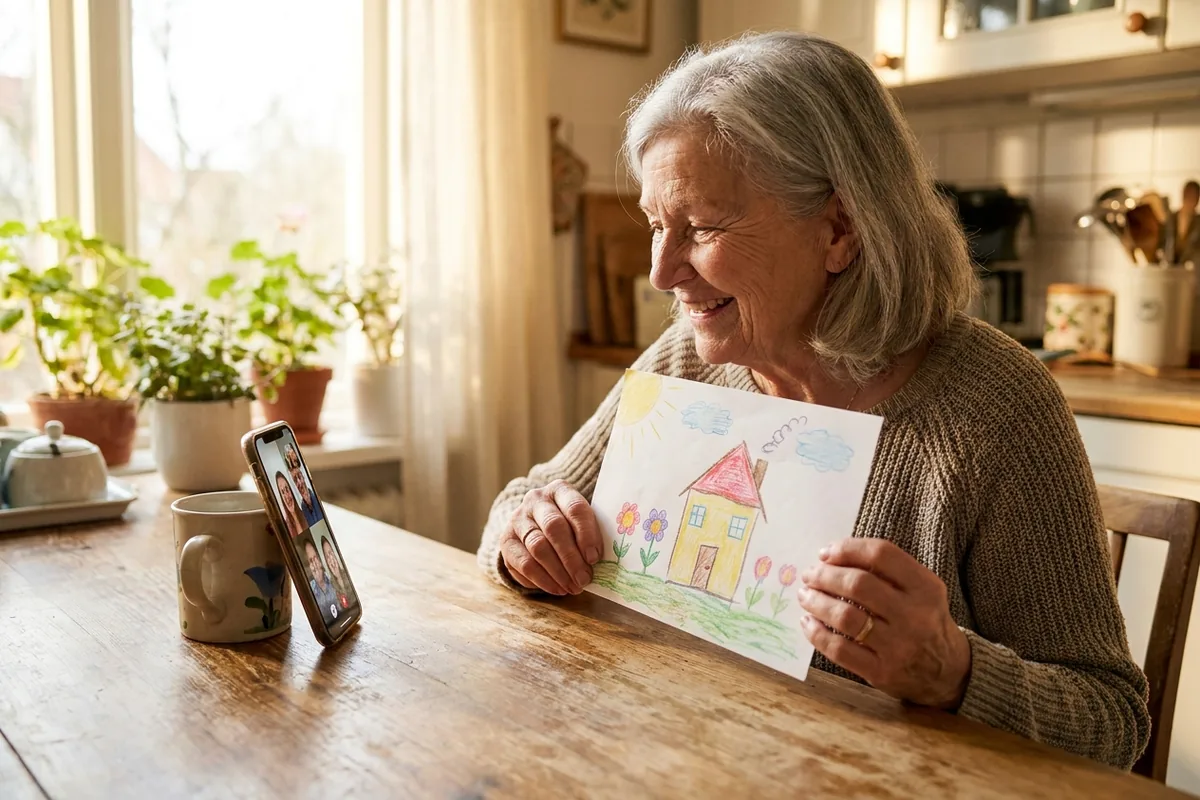
- 4A drawing exchange by post. The child sends a drawing, the grandparent sends one back, however badly drawn. Badly drawn is better.
- 5A postcard habit. A postcard a fortnight with two sentences on it. Children love post addressed to them specifically.
- 6A shared long game. Chess, draughts or noughts and crosses by photograph, one move a day.
- 7Watching the same thing separately, then talking. Works especially well with teenagers, who will discuss a programme long after they have stopped answering how was school.
- 8A garden or windowsill in two places. Same seeds, same week, photographs as they grow.
What makes a video call work with a small child
- Keep it short and end it while it is still going well.
- Give the child something to do, such as show me your Lego, rather than something to answer.
- Let them wander off. A grandparent watching a child play in the background is having a lovely time.
- Prop the phone up rather than holding it, so the call becomes a window rather than a face.
- Do not narrate the child's manners. Being corrected on a call teaches them the call is a test.
Let the grandchildren lead sometimes
Almost every long distance arrangement is designed by the adults, which means the child is permanently in the position of being asked questions by someone they see rarely. Handing over the steering changes the whole feeling of it.
- Let them choose the activity for one call a month. Even if it is a tour of their bedroom for the fourth time.
- Let them teach something. A game, an app, a dance. Being the expert is a completely different experience from being the interviewee.
- Let them call unannounced sometimes, if the grandparent is happy with that. Spontaneity is what closeness feels like.
- With teenagers, accept the channel they actually use. A meme sent at eleven at night is a real message. Answering it counts.
This is also the fix for the child who goes silent on calls. They are not uninterested. They are being asked to perform, and performing is hard. Give them a job instead and they usually talk the whole way through it. Our guide to family group chats across generations has more on keeping the everyday channel open between the calls.
Be Closer shows your whole family on one private map, free to start.
Consent-first, never sold, and gentle on your battery. iOS and Android.
How shared location quietly helps both sides
This one surprises people, because location sharing is usually framed as parents watching children. Between adult households at a distance it does something gentler. It answers the small question that would otherwise be a phone call at an awkward hour.
- A grandmother sees that the family got home from the long drive, at eleven at night, without ringing and waking a sleeping child.
- A daughter sees that her father is back from his morning walk, and does not have to phone to check, which means she never has to ask him whether he is alright.
- Nobody has to send arrived safely messages, which is the message everybody forgets to send.
The framing matters more than the feature. This is only comfortable when it is set up together, in the same room or on the same call, and when it works in both directions so the grandparent can see the family too. One sided sharing where an adult child watches a parent is a different arrangement, and it feels like one.
Be Closer is free to download and works both ways, everyone on the map has agreed to be there, and anyone can turn their sharing off whenever they want. Say that plainly when you set it up, and mean it. If you would like the fuller version of that conversation, our guide to long distance caregiving covers where support helps and where it starts to crowd.
The best thing a map does at this distance is remove the reasons to check up on each other.
Bridging the tech gap kindly
Most technology frustration in families is not about capability. It is about being made to feel foolish. A grandparent who has been sighed at once will stop asking, and then they will stop using the thing, and then they will say they are not good with computers.
- 1Set it up on their device, not yours. Whatever you configure on your phone will not be where they need it.
- 2Pick one app and stay with it. One video app, one messaging app. Choose the one they already have.
- 3Make the icon huge and put it on the first screen. Remove the clutter around it.
- 4Write the steps on paper. Three lines, large print, left by the device. Paper does not run out of battery.
- 5Do a practice call the same day, while you are still there to fix it.
- 6Never touch their phone without asking, and narrate what you are doing while you do it.
- 7Solve the same problem twice without commenting on it. The second time is when it actually sticks.
One more thing worth saying out loud. If a grandparent is not comfortable with video, the telephone is not a failure. A regular voice call at a fixed time does the same job. The ritual is the point, not the medium.
Making visits count without pressure
Long awaited visits carry a weight that ordinary time does not. Everyone wants it to be wonderful, the children get overwhelmed, the grandparents feel they must entertain, and by day three someone is quietly upset in a kitchen.
- Plan less than you want to. One thing a day, at most. The rest is the point of the visit.
- Protect ordinary time. A supermarket trip together, a lazy morning. This is the texture a distant grandparent is missing.
- Give each grandchild a small piece of time alone with them. Half an hour, no siblings. It is often the thing they remember.
- Let the first hour be awkward. Young children need time to re-warm and it is not rejection.
- Leave the next date behind you. Naming when you will next see each other softens the goodbye enormously.
- Take a photograph of the two of them together, not the whole group. Grandparents rarely have one.
And if the grandparents ever come to stay and help while you are away, our guide to when grandma watches the kids covers the practical handover so nobody is guessing about routines.
My father still does Sunday at half past five. Last month my niece spent the whole ten minutes showing him a lizard she had made from a sock, and he asked serious questions about the lizard for the entire call. That is what closeness at a distance looks like. Not the summer week. The sock lizard, on a Sunday, for ten minutes.
Frequently asked questions

Priya writes about the family members we care for at every age, parents living alone, dogs that bolt at squirrels, and the quiet worry in between. She writes the way she checks in: gently, and always dignity first.
Our guides are written by Be Closer's editorial voices and reviewed by the team behind the app. Questions? support@becloser.com
Published · Updated