
 Aging Parents
The Family Group Chat: Keeping Three Generations Actually Talking
A family group chat that spans three generations works when nobody's forced into someone else's communication style, big text and voice notes for grandparents, no pressure to reply instantly for teens, and a shared family map so "did she get home safe?" gets answered without anyone having to ask.
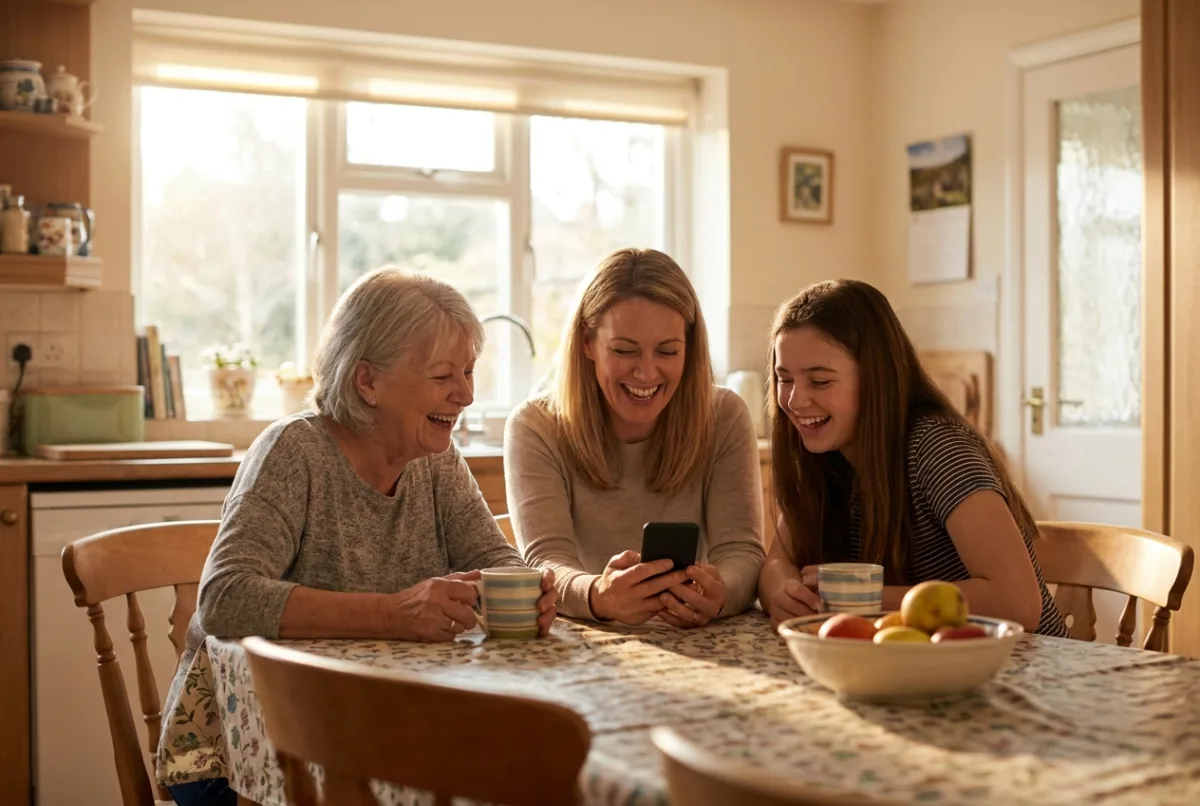
My mother sends voice notes that begin with "Hello, it's me, your mother" as though the app might have gotten confused about who was speaking. My daughter replies to entire paragraphs with a single thumbs-up. I sit in the middle of both of them, in a group chat we started three years ago mostly so nobody would have to repeat news four separate times, and somehow it has become one of the most reliable threads in our family's life.
It didn't start out that way. For the first few months it was mostly my mother asking why nobody had replied to something she sent an hour ago, and my daughter muting the chat entirely for a week after a particularly enthusiastic chain of good-morning messages. Getting three generations to actually talk in the same digital room, rather than past each other, took some real trial and error.
What I've landed on isn't a technical trick. It's a set of unwritten rules that let each person show up the way they naturally would, plus one quiet addition, a shared family map, that answers the question underneath half our messages without anyone having to type it.
The rules nobody wrote down but everyone follows now
The chat works now not because we found the perfect app, but because we stopped expecting everyone to use it the same way. A group chat across generations isn't one conversation, it's three overlapping ones, and treating it that way is what fixed most of the friction.
- No reply-speed pressure. My mother used to worry when a message sat unread for a few hours. We agreed early on: nobody owes an instant response, and "seen" doesn't mean ignored.
- A photo counts as a reply. Half our best exchanges are just pictures, dinner, the dog, a school project, with no caption needed. It lowers the bar for participating.
- Big news gets its own message, not buried in a thread. If something actually matters, it gets a message that starts with the news itself, not three lines of preamble first.
- Voice notes are welcome, not mocked. My mother finds typing slow and voice notes natural. Nobody in the chat teases her for it anymore, and she's more present in the conversation because of it.
What grandparents actually need from a group chat
Most advice about tech and older relatives focuses on teaching them to keep up. What actually helped my mother wasn't a tutorial, it was the rest of us adjusting slightly so the format worked for her too.
Small adjustments that made a real difference
- 1Increasing default text size on her phone so scrolling through messages didn't require reading glasses every time.
- 2Accepting voice notes as a normal contribution rather than something to work around.
- 3Not flooding the chat with rapid-fire back-and-forth that scrolls past before she's had a chance to read it, a habit teenagers fall into easily and older relatives find genuinely alienating.
- 4Pinning important messages (an address, a time, a phone number) so she isn't scrolling back through weeks of chat to find them.
None of this asked her to become a different kind of communicator. It just widened the format enough that her natural way of showing up, warm, a little formal, unhurried, fit inside it.
Be Closer shows your whole family on one private map, free to start.
Consent-first, never sold, and gentle on your battery. iOS and Android.
What teenagers will actually tolerate
My daughter's threshold for family group chats is, to put it gently, low. What keeps her in this one rather than muted permanently comes down to a few things I wish I'd understood sooner.
- Low-stakes participation is fine, a reaction emoji is a genuine reply, not a brush-off, and treating it as one just teaches her to disengage further.
- The chat isn't used to relay instructions or lectures. There's a separate, private channel for that, and keeping it out of the group chat keeps the group chat feeling like a place she wants to be rather than a place she gets managed.
- Nobody screenshots or quotes what she says in the chat back at her later as evidence in an argument. That single rule did more for her trust in the space than anything else.
- She gets to post things that have nothing to do with logistics, a meme, a song, something funny that happened at school, and those get responded to with the same warmth as anything else.
The question the chat can't quite answer, and what does
For all its warmth, the group chat has one blind spot: it's built for sharing moments, not for the quiet logistical worry that sits underneath a lot of family life. "Did she get home safe?" "Is Mum back from her walk yet?" Those questions don't really belong in a chat full of dinner photos and voice notes, and typing them out can feel like it interrupts the tone of the thing.
This is where a shared family map has quietly earned its place alongside the chat rather than inside it. We use Be Closer as a separate, low-key layer, everyone in the family can glance at it, and the questions that used to interrupt the group chat mostly don't need asking anymore. My daughter's dot moving steadily toward home after practice answers the question before I've thought to worry about it. My mother's dot resting at the community centre on a Tuesday afternoon tells me her walking group met as usual, without a single message exchanged.
Two layers, working together
- The group chat: for warmth, moments, news, and the small daily texture of staying connected.
- The shared map: for the quiet logistical reassurance that used to require a check-in text.
- Keeping them separate means the chat stays a place people want to be, not a place that only exists to track each other's movements.
The night I stopped needing to ask 'are you home yet?' in the family chat was the night I realized the map wasn't replacing our conversation, it was making room for a better one.
Frequently asked questions

Priya writes about the family members we care for at every age, parents living alone, dogs that bolt at squirrels, and the quiet worry in between. She writes the way she checks in: gently, and always dignity first.
Our guides are written by Be Closer's editorial voices and reviewed by the team behind the app. Questions? support@becloser.com
Published · Updated