 Aging Parents
When Grandma Watches the Kids: Coordination Without Chaos
Grandparent childcare runs smoothly with a short, clear handoff brief covering allergies, nap windows, and screen rules, while leaving room for grandparents to do things their own way. A shared family map and an emergency info card cover the logistics, but the most important thing to remember is that this is a gift, not free labor.
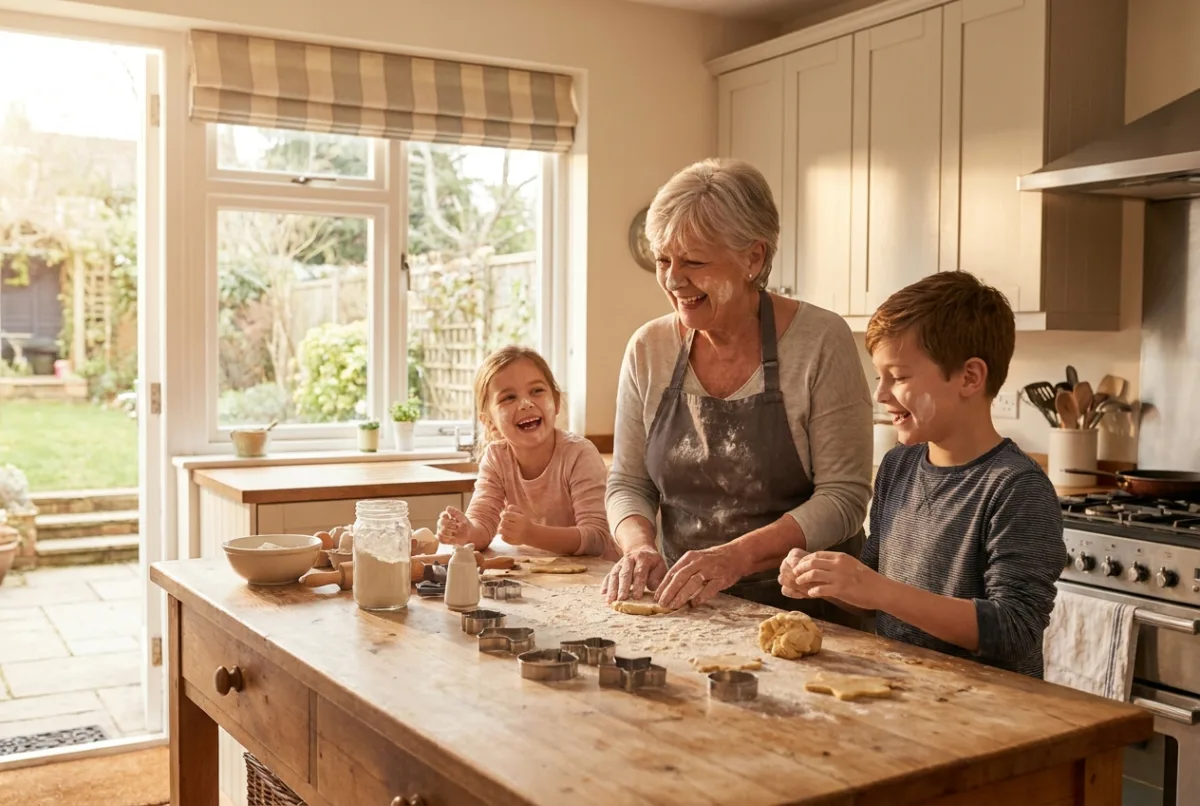
There is flour on my mother's cheek, my youngest is standing on a stool she isn't technically supposed to stand on, and both children are eating raw cookie dough directly off a spoon at eleven in the morning, three hours before lunch. If I had walked in and not known better, I might have panicked. Instead I stood in the doorway for a moment and just watched, because this is what it looks like when my mother watches the kids, and it works, even though almost none of it matches how I'd run the same afternoon myself.
Grandparent childcare is one of the great quiet gifts many families receive, and also one of the more delicate coordination problems in family life. You're handing your children to someone you trust completely and also someone who raised you by a different set of rules, in a different decade, with different instincts about risk and routine. Getting the coordination right, without turning grandma into an unpaid employee following your rulebook, has taken us a few years of adjusting.
Here's what's actually worked, including the parts where I've had to let go of things I initially thought mattered a great deal.
What actually needs to be in the handoff brief?
The handoff brief is the one piece of this I don't compromise on, because it covers the things that actually matter for safety, not the things that just matter to my particular parenting style. Keeping it short is what makes it stick, a long list gets skimmed, a short one gets remembered.
The essential handoff brief
- Allergies and any medication, including exact timing and dosage if relevant.
- Current nap window, and what happens if it's missed (a shorter nap and an earlier bedtime, not a meltdown to manage alone).
- Screen time rules, not zero-tolerance, just what's reasonable so the day doesn't end with three hours of tablet nobody agreed to.
- Any current fears, phases, or sensitivities worth knowing, a new fear of dogs, a phase of not wanting to be picked up a certain way.
- Pickup time and who's doing it, confirmed the morning of, not assumed from last week.
Everything else, meals, activities, exact nap-time rituals, I've learned to leave open. My mother doesn't need a script for how to spend an afternoon with her grandchildren. She needs the handful of facts that actually protect them, and then the freedom to run the rest of the day her way.
Why do grandparents deviate from the rules, and why is that mostly fine?
For a long time, the cookie dough and the ice cream before dinner genuinely bothered me. It felt like a small undermining of rules I'd put real thought into. What shifted my thinking was realizing that grandparents aren't trying to run my household, they're running a different, adjacent thing: an afternoon of being a grandparent, which has its own logic and its own value.
A grandparent's house operating by slightly different rules than the one at home isn't chaos. Children are generally quite capable of understanding that different houses have different norms, dessert rules at grandma's, bedtime rules at home, and that distinction, rather than confusing them, often becomes part of what makes grandma's house feel special.
Where the line actually sits
- Safety rules are non-negotiable, car seats, allergy avoidance, medication timing, supervision near water or roads. These aren't style preferences, and it's fair to hold firm on them.
- Everything else is negotiable, and mostly should be left alone, dessert timing, TV shows, how bedtime stories get read, whether shoes stay on in the house. These are style, not safety, and a grandparent gets to have a style.
- If something genuinely worries you, raise it once, calmly, and specifically, not as a running commentary on how the day went, but as an actual conversation about the actual thing.
My mother told me once that being told exactly how to parent, in her own kitchen, would have made her dread the visits instead of look forward to them. I think about that a lot now.
How does the family map help with school pickups and logistics?
The one area where I've found real, practical value in a shared tool rather than just a conversation is school pickup coordination. On the days my mother collects the kids from school, there used to be a small anxious window every single time, has she left yet, is she stuck in traffic, did she remember it's an early finish today.
A shared family map through Be Closer quietly solved that. She doesn't have to text "on my way" or "just arrived", the movement itself tells the story, and I only glance at it on the days something feels uncertain, like an early dismissal or a change in her usual route. It's the same principle we describe for teenagers in Should I track my child's location?: visibility that's mutual and rarely needed beats a constant stream of check-in texts nobody enjoys sending.
For grandparents who might not be confident drivers in unfamiliar areas, or who are managing an after-school activity schedule that changes week to week, this small bit of shared visibility takes pressure off everyone, she's not anxious about being late and unreachable, and I'm not anxious wondering if the pickup happened.
Be Closer shows your whole family on one private map, free to start.
Consent-first, never sold, and gentle on your battery. iOS and Android.
What belongs on an emergency information card?
This is a small thing that's saved us real stress more than once, a card, printed and kept somewhere obvious (a fridge, a car glovebox), with the essentials written down so nobody has to remember them under pressure.
- 1Both parents' phone numbers, plus one backup contact who isn't a parent.
- 2The children's doctor's name and phone number.
- 3Any allergies and medications, written plainly, not assumed to be remembered.
- 4The nearest urgent care or hospital to grandma's specific address, since it may not be the one you'd default to from your own house.
- 5Insurance details or a note of where to find them quickly.
It's a five-minute task that turns a possible emergency into a manageable one, and it means my mother isn't trying to recall a phone number from memory while also managing two upset children.
How do we remember this is a gift, not free labor?
It's easy, especially when grandparent childcare becomes regular, to start treating it like a scheduling resource rather than what it actually is, a relationship, freely offered, that happens to also solve a logistical problem for us. I've caught myself texting my mother a pickup time with no context, the same way I'd message a paid babysitter, and had to correct course.
What's helped is small, deliberate gratitude that isn't tied to a specific favor, a genuine thank-you after a day, not just a logistical wrap-up; asking her how her afternoon with the kids actually was, not just whether everything went fine; making sure the arrangement flexes around her life too, not just ours, so she can say no to a request without it becoming an issue.
The flour on her cheek, the cookie dough at eleven in the morning, the stool she isn't technically supposed to stand on, none of that is chaos I need to manage. It's an afternoon my children will remember fondly, made possible by someone who didn't have to offer it, and who I try to remember to thank properly, not just coordinate with efficiently.
Frequently asked questions

Priya writes about the family members we care for at every age, parents living alone, dogs that bolt at squirrels, and the quiet worry in between. She writes the way she checks in: gently, and always dignity first.
Our guides are written by Be Closer's editorial voices and reviewed by the team behind the app. Questions? support@becloser.com
Published · Updated