
 Aging Parents
Move Mum Closer, or Help Her Stay? The Question With No Easy Answer
There's rarely a clean answer to whether an aging parent should move closer to family or stay put, the honest process starts with what she wants, not what's convenient for everyone else. Aging in place usually needs more scaffolding than families expect, and there are real middle options between uprooting someone entirely and leaving them to manage alone.
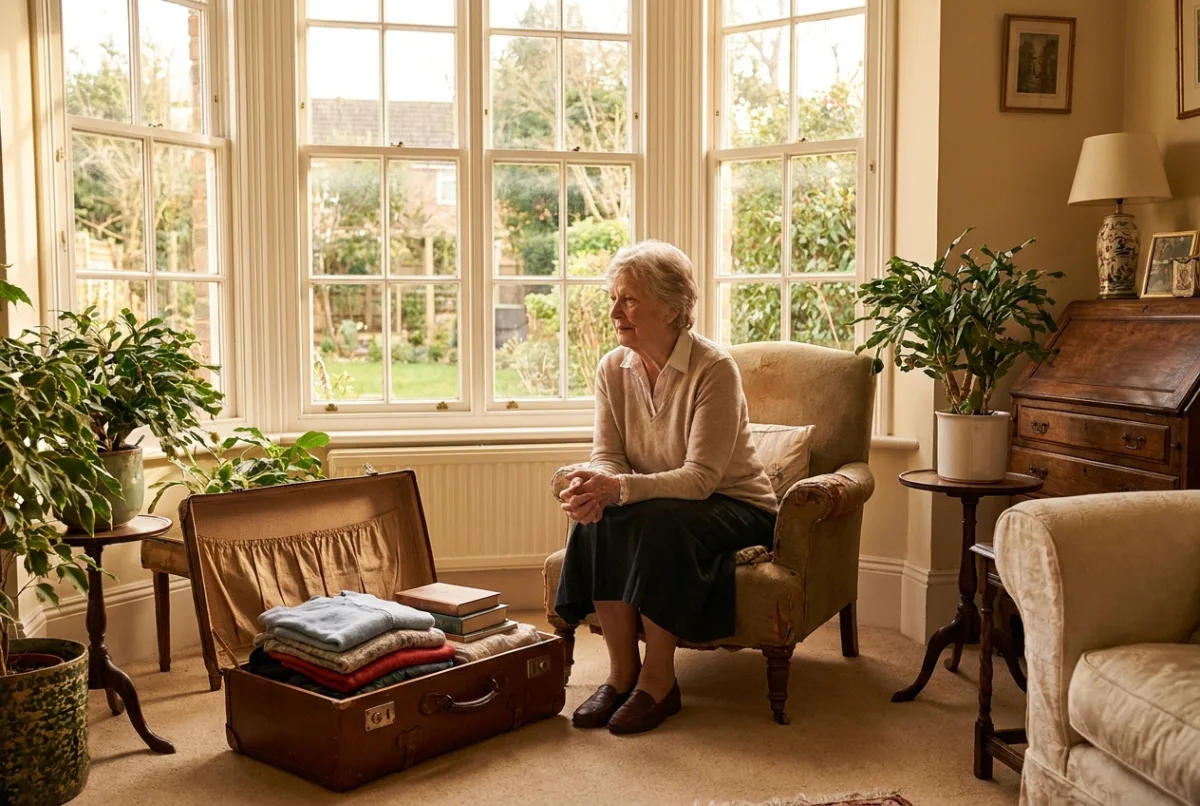
The suitcase sat by my mother's armchair for three days before either of us said anything about it. I'd brought it up from the basement myself, at her request, and there it stayed, half-packed and half-abandoned, a question neither of us was ready to ask out loud: was she actually going to move closer to me, or was pulling out the suitcase just something to do with her hands while she thought about it?
This is a decision more families circle than make. It comes up after a fall, or a diagnosis, or just a winter that felt longer and lonelier than the one before it. And it tends to get framed as a single binary, move her closer, or leave her where she is, when the real question is usually smaller and harder: what does she actually want, and what would it take to make either option work well for her, not just for us.
I don't have a tidy resolution to offer, because we didn't arrive at one. What I have is the process that got us somewhere workable, and I think the process matters more than the outcome.
Why does 'closer' feel so obviously right, and why isn't it?
The pull toward moving a parent closer is powerful and mostly good-hearted. You imagine being five minutes away instead of five hours. You imagine seeing them casually, not as a planned trip requiring flights and time off work. You imagine being there fast if something goes wrong. None of that imagining is wrong. It's also not the whole picture.
What gets lost in the imagining is what your parent is actually giving up. Not just a house, a pharmacist who knows her by name, a neighbor who waters her plants without being asked, a hairdresser she's seen for twenty years, a church or community group, the particular light in her kitchen at four in the afternoon. Rootedness isn't sentimental extra credit. For many older adults it's a genuine protective factor, familiar places require less cognitive effort to navigate, and social ties built over decades don't transplant easily into a new zip code.
My mother said something to me during one of our suitcase conversations that I've turned over since: "I know you want me closer to you. I'm trying to figure out if I want to be closer to me." She meant the version of herself that exists in that house, in that town, among those people, a version she wasn't sure would survive the move intact.
What does 'aging in place' actually require?
"She wants to stay in her own home" is a sentence families say with a kind of finality, as though wanting settles it. It doesn't. Aging in place well is a genuine project, not a default state you fall into by not moving. It requires honest infrastructure, and skipping that step is how a parent's wish to stay put quietly turns into a parent stuck and unsupported.
- A realistic home safety pass, grab bars, adequate lighting, a clear path from bed to bathroom, and rugs that won't catch a foot in the dark. We covered the specifics in Aging parents living alone: a safety setup.
- A local support web that isn't just you, a neighbor with a spare key, a pharmacy that delivers, a friend who checks in on the days you can't call.
- A plan for the predictable emergencies, not just the general worry, what happens if she falls, if the power goes out for three days, if she can't reach the phone in time.
- A communication rhythm that doesn't depend on either of you remembering, a set time to check in, rather than a vague promise to "call more." We wrote about building that habit in Daily check-in rituals that actually stick.
- Transportation that doesn't collapse the moment she stops driving, whether that's a reliable friend, community transport, or a plan you've actually priced out rather than assumed will appear.
None of this is glamorous. It's also the difference between staying in place as a considered decision and staying in place as a slow-motion accident waiting for a bad week.
What lives in the middle, between moving and staying?
The binary is the trap. In practice, most families I've talked to over the years land somewhere in between, and the middle options deserve far more airtime than they get.
Part-year stays
Some parents split the year, summers in the family home, winters closer to family, or the reverse. It isn't for everyone; it requires two functioning households and a parent willing to live a slightly nomadic life. But for a parent who dreads winter isolation more than she dreads change, it can solve the actual problem rather than the imagined one.
A granny flat or in-law suite
Proximity without full cohabitation. She gets her own door, her own kitchen, her own hours, and you get the five-minute drive instead of the five-hour flight. This option asks a lot logistically and financially, and it isn't available to every family, but where it is, it tends to satisfy both the need for closeness and the need for autonomy better than almost anything else.
Tech-supported independence, wherever she is
This is the option that gets underrated because it's unglamorous, but it changes the calculus meaningfully. A parent who stays in her own home with a phone that shares location on request, a simple check-in habit, and a way to call for help fast is a genuinely different proposition from a parent staying in her home with none of that. It doesn't replace human support, but it narrows the gap between "she's five hours away" and "she's five hours away and I have no idea what's happening."
The suitcase, when it finally got unpacked again, wasn't a decision that she was staying forever. It was a decision that we were going to build the middle option properly before assuming we needed the drastic one.
Be Closer shows your whole family on one private map, free to start.
Consent-first, never sold, and gentle on your battery. iOS and Android.
How do you build a decision framework that starts with her, not you?
The single biggest shift in our own process was reordering the questions. We had been starting with our convenience, what would be easiest for the family to manage, who could visit when, what would reduce our own worry fastest, and only getting to her preferences afterward, if at all. Flipping that order changed the entire conversation.
- 1Ask what she actually wants, before presenting any option. Not "would you consider moving closer to us" but "if nothing else mattered, where would you want to be, and why." The why matters more than the where.
- 2Separate her fears from your fears. She may fear losing her independence and her community. You may fear a phone call in the middle of the night. Both are legitimate, but they call for different solutions, and conflating them tends to produce a decision that solves nobody's actual fear.
- 3Test the middle options before ruling them out on cost or logistics alone. Price the granny flat. Call about part-year housing. Try tech-supported independence for three months before assuming a move is the only fix.
- 4Set a review point, not a permanent verdict. Whatever you decide doesn't have to be forever. A trial period with an actual date to revisit it removes the pressure of getting it perfectly right on the first attempt.
- 5Let her change her mind without it feeling like a failure. Wanting to stay and later wanting to move, or the reverse, isn't inconsistency. It's a person responding honestly to how things actually feel once they're living them, which is more information than any hypothetical conversation can give you.
Questions worth asking before any decision
- What would you miss most if you left this house?
- What worries you most about staying?
- Who, besides family, would you lose easy access to?
- What would make you feel safe here without anyone moving?
- If we tried something for three months, what would tell you it was working?
What did we actually decide?
My mother stayed. We spent the money we might have spent on moving expenses on a proper home safety pass instead, added grab bars she initially resisted and now doesn't notice, and set up a shared family map through Be Closer so I can see, without asking, that she's up and moving by mid-morning most days. We agreed on a call every evening at seven, not because either of us needs to report in, but because a habit is easier to keep than a good intention.
It isn't the ending where everyone moves into one happy multigenerational household, and it isn't the ending where she's five minutes from my kitchen table. It's the ending where she's still herself, in the house with the light she likes at four in the afternoon, and I sleep a little easier than I did before the suitcase came up from the basement.
The suitcase is back in the basement now. I think, someday, it'll come up again, a different winter, a different health scare, a different conversation. When it does, I hope we start where we started this time: with her answer to the question, not ours.
Frequently asked questions

Priya writes about the family members we care for at every age, parents living alone, dogs that bolt at squirrels, and the quiet worry in between. She writes the way she checks in: gently, and always dignity first.
Our guides are written by Be Closer's editorial voices and reviewed by the team behind the app. Questions? support@becloser.com
Published · Updated