 Aging Parents
Helping a parent get their confidence back after a fall
After a fall, the biggest risk to an older person's independence is usually the fear that follows, not the injury itself. Rebuild confidence in stages, starting with short accompanied walks, and treat home changes as ordinary household design decisions made with your parent rather than safety measures imposed on them. Keep the check-in rhythm light and mutual, and raise any pattern of falls with a GP as a curiosity rather than a case file.
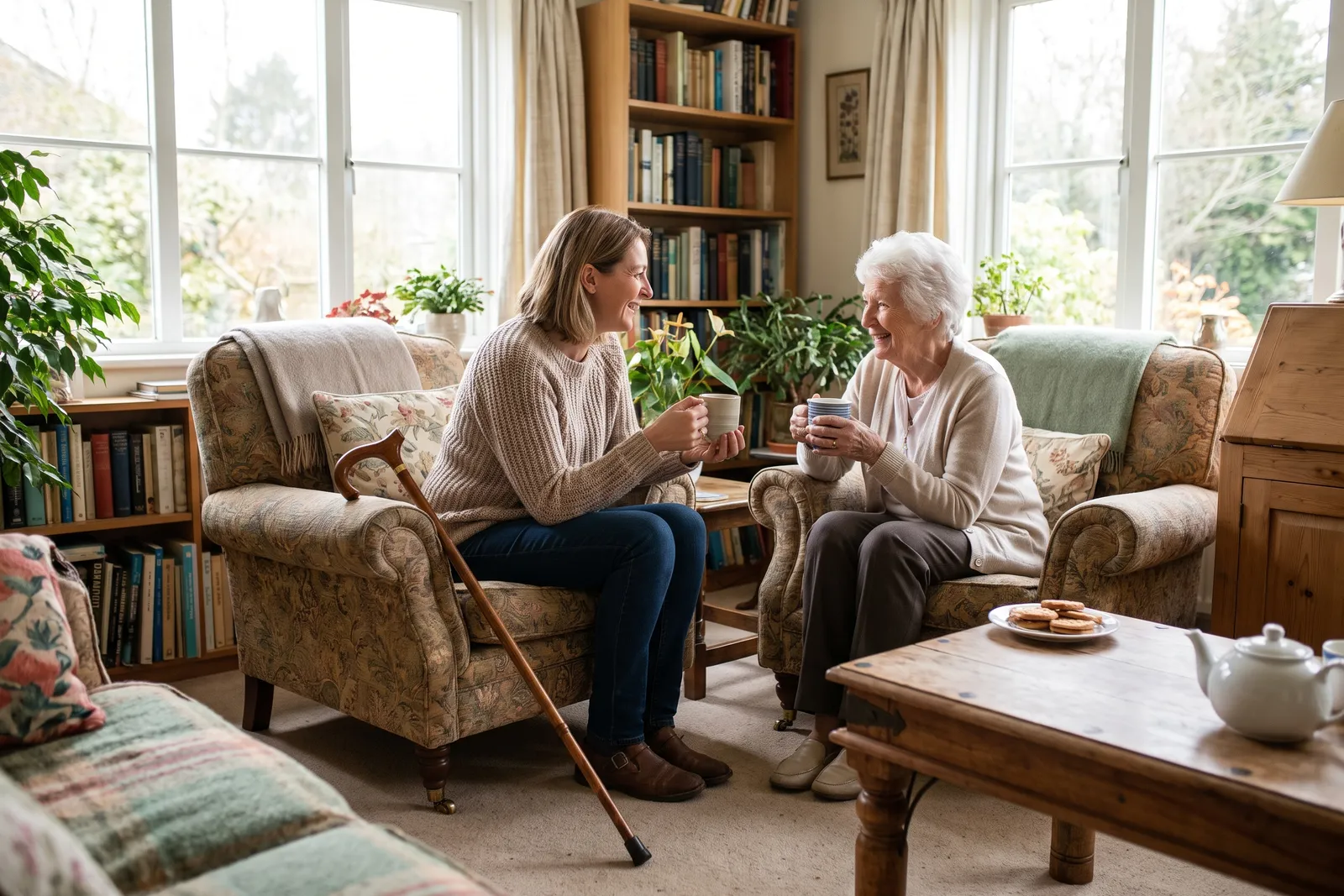
My mother fell in her hallway on a Tuesday in November, on the rug she had walked over ten thousand times. She was not badly hurt. A purple hip, a scraped elbow, an hour on the floor before she managed to reach the phone. The hospital sent her home the same evening with paracetamol and a leaflet. Everyone agreed she had been lucky.
Three weeks later the bruise had faded to yellow and she had not left the house once. She had stopped going to the corner shop, stopped her Thursday coffee, and started sitting in the chair nearest the door. That was when I understood something nobody had said out loud in the hospital: the fall lasted two seconds, and the fear was going to last considerably longer.
This guide is about that second part, the part with no discharge letter. It is about helping someone rebuild the confidence to move around their own life again, and doing it in a way that leaves their dignity exactly where you found it. Because the fastest way to shrink a person's world is to start treating them as fragile, and the people who love them most are usually the ones who do it first.
Why the fear does more damage than the fall
A fall rewrites something quietly. Before it, a person walks through their home without thinking. Afterwards, every step is a decision. The hallway becomes a calculation, the bath becomes a risk assessment, the front step becomes a reason to stay in. Nobody announces this. It shows up as declined invitations and a fridge with less in it.
The cruel part is that avoidance makes the next fall more likely, not less. Legs that stop walking get weaker. Balance that is never challenged gets worse. Confidence that is never used does not sit in storage waiting, it evaporates. So the well meaning instinct, sit down Mum, I will get it, is often the thing that does the long term harm.
A fall injures a body for a few weeks. Being treated as breakable injures a person for much longer.
This is why the goal is never simply preventing another fall. If prevention were the only aim, the safest thing would be a chair and never leaving it, and we all know that is not safety, it is a slow surrender. The aim is a life that stays as wide as possible, with the risks sensibly trimmed at the edges.
Listen for what they are not saying
Older people rarely announce that they are frightened. They say the weather looks bad. They say they were not really in the mood. They say they will go next week. If you hear three next weeks in a row, that is the fear talking, and it deserves a direct but kind question: has walking felt different since you fell? Asked once, calmly, without a follow up plan already prepared.
The home walk-through, done with them and not to them
Almost every family does some version of the home safety sweep after a fall. Most do it wrong, and I say that as someone who did it wrong. I arrived at my mother's house with a notepad and started listing hazards out loud in her own living room, in front of her, as though she were not there. She went very quiet. It took me a while to realise I had walked into her home of thirty years and started describing it as a danger.
The fix is small and it changes everything. Do the walk-through together, and frame it as household design rather than risk management. You are not removing hazards, you are making the place work better. Same actions, entirely different conversation.
Four things worth looking at, in this order
- Floors. Loose rugs, trailing flexes, that one raised threshold between rooms. A rug that slides is the single most common thing a family can fix in an afternoon.
- Light. Getting up at night is when a lot of falls happen. A lamp within arm's reach of the bed and a low light in the hallway matter more than most people expect.
- Handholds. A rail by the bath or beside the front steps. Ask where they already put a hand out of habit, then put something solid exactly there.
- Footwear. Backless slippers are wonderful and treacherous. A pair with a proper back and a grippy sole, bought together and chosen by them, is a genuinely good afternoon out.
Notice that every item above is a change to the house, not a restriction on the person. That distinction is what lets someone accept help without feeling diminished by it. If you want a fuller room by room version, the checklist in aging parents living alone safety setup covers the same ground in more detail.
Let them veto things
My mother refused to give up the hall rug. It had been my grandmother's. So we bought anti-slip backing for it instead, which took ten minutes and cost almost nothing, and she kept the rug. If I had insisted, I would have won the argument and lost far more than a rug. Give people the right to say no to your suggestions and they will say yes to many more of them.
Rebuilding confidence in stages
Confidence comes back the way it left, gradually and through repetition. What does not work is the grand relaunch, a big family outing three weeks after a fall that ends with everyone exhausted and the parent more frightened than before. What works is a ladder with rungs close enough together that nobody has to stretch.
- 1Inside, alone, deliberately. Walking the length of the hallway and back a few times a day, on purpose rather than only when needed. This is not exercise so much as proof.
- 2To the gate, with company. Short, accompanied, and finished while they still feel fine rather than when they are tired. Stopping early is the whole trick.
- 3Round the block, with company. Same route each time. Familiarity is doing real work here, because a known pavement takes less concentration than a new one.
- 4The same route, alone, with a soft safety net. They go, you know roughly when to expect them back, and nobody makes a performance of it.
- 5Back to the thing they actually missed. The coffee morning, the shop, the bus into town. This is the destination, and everything above was scaffolding.
Move up a rung only when the current one has felt boring twice. Boredom is the signal you are waiting for. And when there is a wobble, and there usually is, drop back one rung without commentary. No sighing, no I told you. Just a shorter walk tomorrow.
| Stage | What it looks like | What you are building |
|---|---|---|
| First fortnight | Indoor walking, sitting to standing practice, normal daily tasks | Strength and the habit of moving |
| Weeks three to six | Accompanied short walks, same route, ended early | Trust in their own legs outdoors |
| Weeks six onward | Solo outings, a loose expected return time | Independence, with a quiet safety net |
These timings are a shape, not a prescription. Someone recovering from a fractured wrist and someone with a bruised hip and a bad fright will move at different speeds, and a physiotherapist who has actually seen your parent will always beat a guide written for everyone.
Be Closer shows your whole family on one private map, free to start.
Consent-first, never sold, and gentle on your battery. iOS and Android.
When to mention it to the GP, and how
One fall on a wet step is an accident. Three near misses in a month is a pattern, and patterns are worth a professional's attention, because falls often have a cause underneath them that is fixable. Blood pressure that drops on standing, a medication combination that causes dizziness, eyesight that has quietly changed, an inner ear problem. These are ordinary things with ordinary answers.
What stops families raising it is the fear of what a doctor's appointment might trigger, a conversation about independence that nobody feels ready for. I understand that fear. But it is worth remembering that the appointment usually goes the other way: most of what a GP can do here helps someone keep going, not stop.
Bring facts, not a dossier
- When it happened and what they were doing. Standing up quickly, reaching up, coming down stairs.
- How they felt just before. Dizzy, lightheaded, legs gave way, tripped. These point at very different causes.
- A current list of medicines, including anything bought over the counter.
- Anything that has changed recently, such as new tablets, new glasses, a bout of illness.
Keep the notes short and share them with your parent before the appointment. Nobody should discover in a consulting room that their child has been keeping a written record of their stumbles. That is the difference between an ally and a supervisor, and it is the sort of thing people do not forgive quickly. If you are trying to judge whether this is a one off or part of something bigger, signs your aging parent needs more help is a more careful look at that question.
Check-in rhythms that calm the family down
Here is a thing worth saying plainly: a lot of what happens after a parent falls is about the family's anxiety, not the parent's safety. The adult children cannot sleep. So they phone more, visit more, ask more questions, and the parent starts to feel like a patient in their own kitchen. Managing your own worry is part of caring well, and it is the part nobody warns you about.
The answer is rhythm. A predictable, low effort contact pattern that everyone agrees on in advance beats sporadic anxious phoning every time. A message in the morning. A proper call on Sunday. That is enough for most families, and it stops the phone ringing becoming an event that means something has gone wrong.
Where location sharing fits, and where it does not
When my mother started walking to the shop again, we set up location sharing between us. Both ways, so I appeared on her map exactly as she appeared on mine. She thought this was very funny, and checked where I was more often than I checked on her, which was rather the point. It stopped being surveillance the moment it went in both directions.
Used well, it is not for watching. It is for the twenty minutes when someone is later back than expected and you would otherwise be phoning round. Be Closer is free to download and shows accuracy of up to 95%, which is plenty for knowing that someone is on the high street and simply talking to a neighbour. It cannot tell you that someone has fallen, and any tool that suggests it can is overselling itself.
- Set it up together, on their phone, with them holding it, so they see exactly what is shared.
- Make it mutual. If they can see you too, it reads as family rather than monitoring.
- Agree when you would actually look. Ours was, if you are not back an hour after you said, I will glance at the map and then call.
- Let them switch it off. A consent that cannot be withdrawn was never really consent, and knowing they can turn it off is usually why they leave it on.
The point of a safety net is that you can forget it is there. If you are staring at it, it has stopped being a net and become a leash.
What recovery actually looks like
It took my mother about four months to get back to Thursday coffee. Not four months of steady progress either. There was a fortnight in January where she would not go past the gate, after she watched a neighbour slip on ice, and I remember feeling genuinely defeated by that. Then in February she walked to the shop for milk without telling anyone and rang me afterwards, mildly pleased with herself, mostly to complain about the price of milk.
That is what it looks like. Not a graph, a series of ordinary days with a general direction. The families who cope best with this are the ones who stop marking progress and start just having a parent again, someone with opinions about milk prices rather than a person being managed.
If you take one thing from this: your parent has not become a different person. They have had a frightening thing happen and they need a bit of help getting round it, the same as anyone would. Keep asking what they want rather than announcing what is safest, and the independence you are trying to protect tends to protect itself. Families spread across different cities face a version of this with an extra layer of distance, which is the subject of long distance caregiving.
Frequently asked questions

Priya writes about the family members we care for at every age, parents living alone, dogs that bolt at squirrels, and the quiet worry in between. She writes the way she checks in: gently, and always dignity first.
Our guides are written by Be Closer's editorial voices and reviewed by the team behind the app. Questions? support@becloser.com
Published · Updated