
 Aging Parents
When an aging parent stops cooking: gentle ways to help without taking over
When an aging parent stops cooking, the cause is often practical (tiredness, cooking for one, grief, a sore back) and sometimes a sign of something more. Notice quietly, raise it with curiosity rather than alarm, and offer help that keeps them in charge: shared cooking, a few easy staples, occasional delivered meals. If the change comes with weight loss, confusion or low mood, talk to their doctor.
The first thing I noticed in my mother's kitchen was the smell, or rather, the lack of one. For forty years her kitchen had smelled of cumin and onions and something always simmering. That autumn it smelled of nothing at all. The fridge held milk, a jar of pickle and three yoghurts. On the counter sat a neat tower of crackers.
She said she was fine. She said it was silly to cook a whole pot for one person. Both of those things were true, and neither of them was the whole story. It took me a few clumsy weeks to understand that what she had lost was not the ability to cook, but the reason to.
If you have opened a parent's fridge recently and felt your stomach drop, this guide is for you. **Stopping cooking is rarely about food alone, and the help that works best is the help that leaves your parent holding the spoon.**
The quiet signals worth noticing
Most parents do not announce that they have stopped cooking. The change shows up sideways, often during an ordinary visit. Try to notice without inspecting, the way you would notice a friend looked tired.
- A fridge that looks the same every visit, or food well past its date that nobody has thrown away.
- Meals replaced by snacks: toast, biscuits, cereal at dinnertime, tea instead of lunch.
- Pans that have not moved, a cold oven, a hob used only for the kettle.
- Clothes fitting more loosely, or a comment that they are simply not hungry anymore.
- Takeaway containers piling up, which can be perfectly fine, or a sign that cooking has become too much.
None of these alone means something is wrong. Plenty of people happily eat simply in later life. What matters is change. If your dad cooked a roast every Sunday for decades and now has not turned the oven on in months, that shift is the signal, not the toast.
Common reasons behind the change
- Cooking for one feels pointless after a partner dies or moves into care.
- Standing at the counter hurts, or lifting a heavy pan feels risky.
- Shopping has become harder without driving.
- Low energy, low mood or loneliness has drained the appetite.
- Recipes that were automatic now feel confusing to follow.
How to bring it up without shaming
The way you open this conversation shapes everything after it. A parent who feels caught out will defend the crackers to the end. A parent who feels cared for may tell you what is really going on.
Lead with curiosity, not a diagnosis. "I noticed you are not cooking much lately, what's changed?" lands very differently from "You're not eating properly." The first invites a story. The second invites an argument.
- Pick a relaxed moment, ideally side by side doing something else, like washing up or walking.
- Talk about yourself first: "I hardly cook when I'm on my own either, it feels like so much effort."
- Ask what they miss eating. Appetite often returns with a craving, not a lecture.
- Avoid counting what is in the fridge out loud. It feels like an audit.
Ask what they miss eating, not what they have stopped doing.
If your parent bristles, let it go for now and come back to it another day. Our guide on what to do when an aging parent refuses help goes deeper on keeping the door open when the first answer is no. Pushing hard in one visit almost always costs more than it gains.
Shared cooking rituals that bring the kitchen back
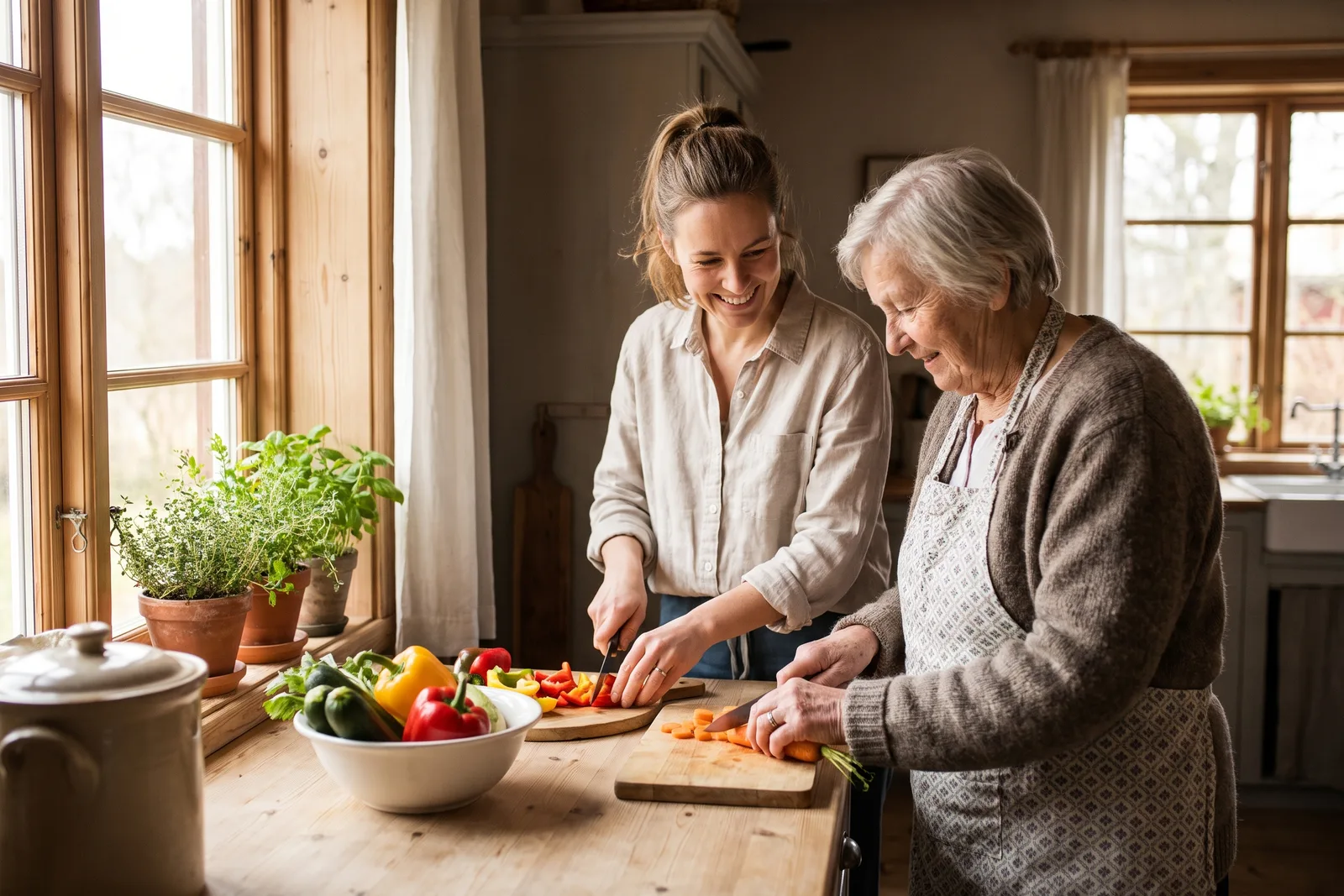
In the end, what helped my mother most was not a meal plan. It was Thursday. Every Thursday I came over and we cooked one dish together, her recipe, her pans, her rules. I chopped. She seasoned and corrected me. We made enough for three more meals and froze them in small boxes she labelled in her careful handwriting.
A shared cooking ritual gives back the two things solo cooking takes away: company and purpose. It also lets you see quietly how your parent is managing, whether a heavy pot is now a struggle, whether a familiar recipe still flows.
- 1Choose a regular slot that fits both your lives, even every other week.
- 2Let your parent choose the dish and lead. You are the assistant.
- 3Cook in a batch and portion it into single servings for the freezer.
- 4If you live far away, cook together on a video call, each in your own kitchen, same recipe.
- 5Invite a grandchild now and then. Teaching a family recipe is a gift in both directions.
For long-distance families, the video call version can be surprisingly lovely. It pairs well with a regular rhythm of contact; our piece on how often to call your aging parents has ideas for building those calls into the week.
Meal trains and delivery, without taking over
Sometimes shared cooking is not enough, or not possible. Delivered meals, a rota of neighbours and family, or a simple grocery order can fill the gap. The risk is that help arrives as a takeover, and your parent starts to feel like a project.
- Offer choices, not decisions. Show two or three meal services and let your parent pick, or decide against all of them.
- Start small. Two delivered dinners a week is easier to accept than a full plan.
- Keep some cooking theirs. Stock easy staples (eggs, soup, frozen vegetables, good bread) so they can still make something themselves.
- Make a meal train feel social. Ask family members to stay for a cup of tea when they drop food off, rather than leaving a box at the door.
- Adjust the kitchen. A stool at the counter, lighter pans and a kettle that is easy to lift can make cooking feel possible again.
If your parent lives alone and you worry about the days between visits, a gentle check-in routine can help. Some families use Be Closer, a free family app, so a parent can share their location with consent and see arrivals at the shops or the community lunch without anyone needing to ring. It does not tell you whether someone has eaten, and it should never replace a visit or a call. Technology can make the days between visits less anxious, but it cannot share a meal.
Be Closer shows your whole family on one private map, free to start.
Consent-first, never sold, and gentle on your battery. iOS and Android.
A few easy meals that still feel like cooking
Part of helping is lowering the bar for what counts as a proper meal. Many parents grew up believing dinner meant hours at the stove. Giving permission for simpler food can be a relief, as long as it still feels like their own cooking.
- Eggs any way, with toast and a few tomatoes, ready in ten minutes.
- Soup from the freezer, made together on a ritual day, with good bread.
- A tray bake: vegetables and a little chicken or fish on one tray, one oven, one pan to wash.
- Familiar comfort dishes in small portions, so cooking one serving does not feel wasteful.
Write a short list of these together and stick it inside a cupboard door. When cooking feels easy, it feels possible again.
When not cooking signals something more
Most of the time, a parent who stops cooking needs company, convenience and a little practical help. Occasionally, though, it is one of the first visible signs of a bigger change, and it is worth knowing when to look further.
Talk to their doctor if you notice
- Noticeable weight loss or clothes suddenly much looser.
- Confusion with familiar recipes, or pans left on the hob.
- Persistent low mood, withdrawal or loss of interest in things they loved.
- Trouble swallowing, chewing or a sudden change in appetite.
Encourage your parent to mention appetite and cooking at their next appointment, or ask if you can come along. Frame it as looking after their energy, not as a test. Our guide to the signs an aging parent needs more help covers other changes worth watching for alongside this one.
Loneliness deserves a special mention. For many older people, a meal was always a shared thing. When the table empties, the cooking stops. If that sounds familiar, our piece on helping an aging parent with loneliness may be the more important read.
Keeping the kitchen theirs
My mother cooks on her own again now, not every night, but most. The Thursday ritual is still going. Last week she phoned me just to tell me she had made her lentil soup from scratch, and she sounded like herself. I did not save her kitchen. I simply stood in it with her until she wanted to come back.
Your goal is not to feed your parent. It is to help them keep feeding themselves, for as long as that brings them joy. Notice gently, ask kindly, offer help that keeps them in charge, and watch for the moments when a doctor should be part of the conversation. The rest happens one shared pot at a time.
Frequently asked questions

Priya writes about the family members we care for at every age, parents living alone, dogs that bolt at squirrels, and the quiet worry in between. She writes the way she checks in: gently, and always dignity first.
Our guides are written by Be Closer's editorial voices and reviewed by the team behind the app. Questions? support@becloser.com
Published · Updated