 Aging Parents
How to Help an Aging Parent Who Seems Lonely
Loneliness in an older parent usually shows up sideways, as longer calls, less going out, or fading interest in things they loved. The fix is not more supervision but more genuine contact: a few reliable rituals, help rebuilding local connections on their terms, and making it easy and safe for them to reach out first.
The year after my father died, my mother told me she was doing fine at least twice a week. She was. The bills were paid, the garden was tidy, and she had learned to work the boiler. What she was not doing was seeing anyone, and it took me an embarrassingly long time to notice.
The clue, in the end, was the cat. Our calls had grown longer, and a surprising amount of them were about the neighbours' ginger tom, where he slept, what he stole, how he looked at her through the glass. I laughed along until I realised that cat was the most regular visitor she had.
Loneliness in older parents is rarely announced. It hides behind pride, behind not wanting to be a burden, and behind the very real competence of someone who has run a household for fifty years. This guide is about noticing it kindly and helping without turning your parent into a project.
The quiet signs worth noticing
Retirement, bereavement, a friend moving to be near their grandchildren, giving up the car. Each of these removes a thread of daily contact, and nobody sends a card for the loss of a Tuesday coffee group. The change is gradual, which is exactly why it is easy to miss from a distance.
- Calls get longer, or much shorter. Either can mean the phone has become the main event of the day.
- Plans quietly disappear. The choir, the walking group, the church lunch are mentioned in the past tense.
- Small details about strangers. The postman, the pharmacist, the cat. These are the conversations they are still having.
- Less care with routines they used to love. Cooking for one feels pointless, so they stop.
- Reluctance to hang up. New stories start just as you say goodbye.
None of these is a diagnosis. Grief looks like this for a while, and so does a quiet person enjoying quiet. If you notice low mood that does not lift, changes in sleep or appetite, or talk of feeling pointless, that is a conversation for their doctor, and it is worth gently suggesting it. Loneliness and depression overlap, and the second deserves proper care.
Lonely people rarely say they are lonely. They tell you about the cat.
Start with a conversation, not a plan
My first instinct was to fix it. I researched every club within five miles and emailed my mother a list. She was, rightly, a bit hurt. I had skipped the part where I asked her how she felt, and I had treated her life like a problem to solve.
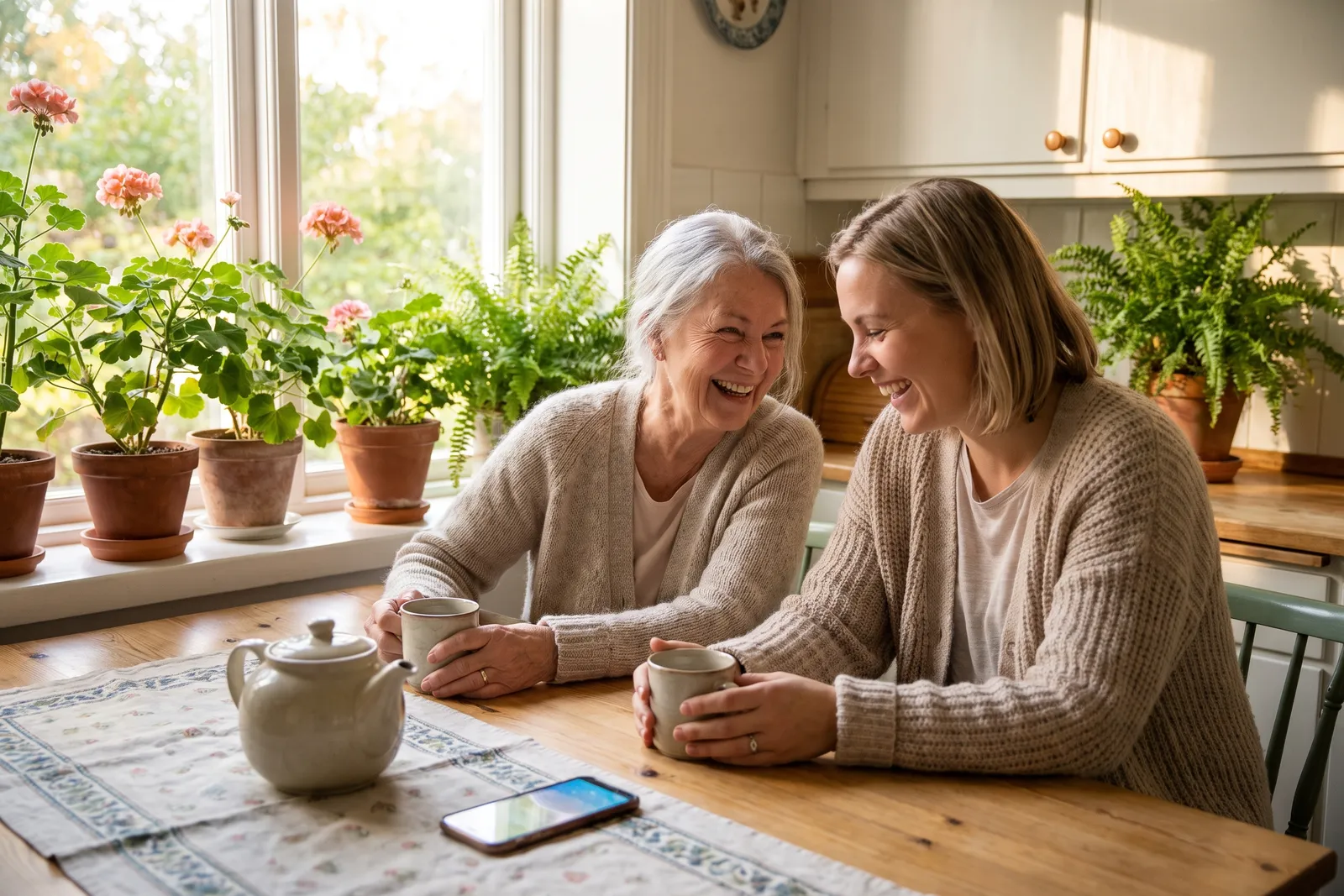
The second attempt went better. On a visit, over tea, I said that the house felt very quiet now and asked whether she found it quiet too. She put her cup down and said yes, the evenings were the worst. That one honest sentence gave us something to work with.
Questions that open the door
- "What does a good week look like for you now?" It invites them to describe what they want, not what they lack.
- "Who have you seen lately?" Asked with curiosity, not as an audit.
- "What do you miss doing?" Often the answer is a person or a place, not an activity.
- "Is there anything that would make it easier to get out?" Transport, confidence, and cost are common hidden barriers.
Your parent is the expert on their own life. Your job is to listen well enough to find the one or two changes they actually want.
Rituals that create genuine contact
Random calls, however loving, are hard to look forward to. A ritual is different. It is a fixed point in the week that both of you can plan around, and knowing it is coming matters almost as much as the call itself. If you are unsure how often is right, how often should you call your aging parents walks through finding a rhythm that suits you both.
- A standing call. Same day, same time. Ours is Sunday at five, and my mother lays the table for it with a pot of tea.
- Shared errands. A video call while she does the weekly shop list, or a joint online order where she picks the treats.
- Parallel activities. Watching the same programme and texting about it, or both doing the Saturday crossword and comparing answers.
- Small daily touches. A photo of the children, a good morning message, a voice note. Tiny, but they add up to company.
The rituals that last are the ones that feel mutual. My mother tells me about her garden, and I ask her advice on mine. Contact that only flows one way starts to feel like a check-up. For more ideas, daily check-in rituals has gentle ones that do not feel like monitoring.
Help them feel confident reaching out first
Many older parents wait to be called because they do not want to interrupt. My mother would sit with news for days rather than ring me at work. Part of fixing loneliness is giving your parent permission, and the practical tools, to start the contact themselves.
- 1Say it plainly. Tell them you love hearing from them and that there is no wrong time to send a message.
- 2Make it easy. Put family favourites at the top of their phone, set up a family group chat, and show them voice notes, which many parents find more natural than typing.
- 3Practise together. Sit side by side and have them send a photo to a grandchild. Confidence comes from doing it once with someone kind watching.
- 4Reply warmly and quickly. The first few messages set the tone. A delighted response makes the next one more likely.
If the phone itself is the barrier, teaching an aging parent to use a smartphone covers how to do it patiently, one skill at a time, without taking over.
Be Closer shows your whole family on one private map, free to start.
Consent-first, never sold, and gentle on your battery. iOS and Android.
Rebuilding local connection, with dignity
Calls help, but a person in the same room helps more. The goal is not to fill their calendar. It is to reconnect them with one or two places where they are known by name, on terms that feel like their choice.
- Revive an old thread first. A lapsed friendship or a former club is easier to return to than something new.
- Start with a purpose. Volunteering, a class, or a community garden gives people something to do besides meet strangers.
- Solve the transport. A bus route written down, a lift from a neighbour, or a regular taxi can be the whole difference.
- Go with them once. Offer to come to the first session, then step back.
- Respect a no. Some people are content with less company than we imagine. Ask again later, gently.
My mother eventually joined a Thursday knitting group at the library. I did not choose it. She saw a poster and mentioned it twice, and all I did was ask whether she would like me to find out the details. She went. The ginger cat now gets a lot less airtime.
Where a shared family map helps, and where it does not
Location sharing can take some pressure off both sides, as long as it is agreed openly and your parent chooses it. With Be Closer, my mother and I share a family circle she set up with me. When an arrival alert tells me she has reached her knitting group, I do not need to ring to check she got there. When I see she is home again, I send a message asking how it went.
That is the honest value: fewer anxious calls, more warm ones. It is also a comfort for parents who worry about being a nuisance, because family can see they are fine without asking. If you live far away, long-distance caregiving covers how this fits into a wider support plan.
The honest limits
- A dot is not a visit. A map tells you where someone is, never how they feel.
- Accuracy varies. Phone location is up to 95% accurate in good conditions, and less so indoors.
- Consent comes first. Your parent should know exactly who can see them, and be able to pause or leave the circle.
- It cannot cure loneliness. Used well, it frees up your calls for connection rather than logistics.
Be Closer is free to download, available in 13 languages, and holds 4.4 stars across more than 150,000 ratings on the App Store and Google Play. None of that replaces Sunday tea. It just means Sunday tea can be about the knitting instead of whether she locked the door.
Look after yourself, too
Carrying a parent's loneliness is heavy, especially if you are also grieving or far away. You do not have to be their only company, and you should not try. Siblings, grandchildren, old friends, and neighbours can each hold a thread.
You are not failing if they are sometimes lonely. Everyone is, now and then. What matters is that they know they are loved, that reaching out is welcome, and that the door is open in both directions.
Frequently asked questions

Priya writes about the family members we care for at every age, parents living alone, dogs that bolt at squirrels, and the quiet worry in between. She writes the way she checks in: gently, and always dignity first.
Our guides are written by Be Closer's editorial voices and reviewed by the team behind the app. Questions? support@becloser.com
Published · Updated